


Daily Comment (October 27, 2026)
by Patrick Fearon-Hernandez, CFA, and Thomas Wash
[Posted: 9:30 AM ET] | PDF
Our Comment today opens with news of a European Union subsidy for aircraft maker Airbus that the US administration has warned could be a violation of the recent US-EU trade deal. We next review several other international and US developments that could affect the financial markets today, including proposed new US investment curbs that could undermine the current effort by President Trump and General Secretary Xi to ease bilateral tensions and a preview of the Federal Reserve’s policy meeting, which starts today.
United States-European Union: Yesterday, US Trade Representative Jamieson Greer accused the European Investment Bank of failing to share details about the $3.4 billion loan that it made to airliner manufacturer Airbus in June, despite “ongoing requests.” Greer also warned that the money could lead to market distortions constituting a violation of the recent US-EU trade deal. His complaint is a reminder that trade tensions and retaliatory measures between the US and its trading partners are still a risk and could drive down the stock prices of targeted companies.
United States-China: In a little-noticed proposal late last week, the Treasury Department said it wants to tighten its curbs on US investments in Chinese technology firms. The proposed rule would broaden the Treasury’s current investment restrictions to include radiation-hardened integrated circuits (ICs), photonic ICs, high-bandwidth memory, “additional categories of advanced ICs,” algorithms or applications for quantum computing, and biotechnologies.
- As we’ve mentioned before, US President Trump and Chinese General Secretary Xi have adopted a new, détente-like policy of “Constructive Strategic Stability” (see our latest Bi-Weekly Geopolitical Report) to cool tensions.
- Nevertheless, the two leaders’ bureaucracies continue to take steps that might rekindle conflict between the two sides. That, in turn, could serve to undermine the prospects for Chinese stocks or for US firms that do a lot of business in China.
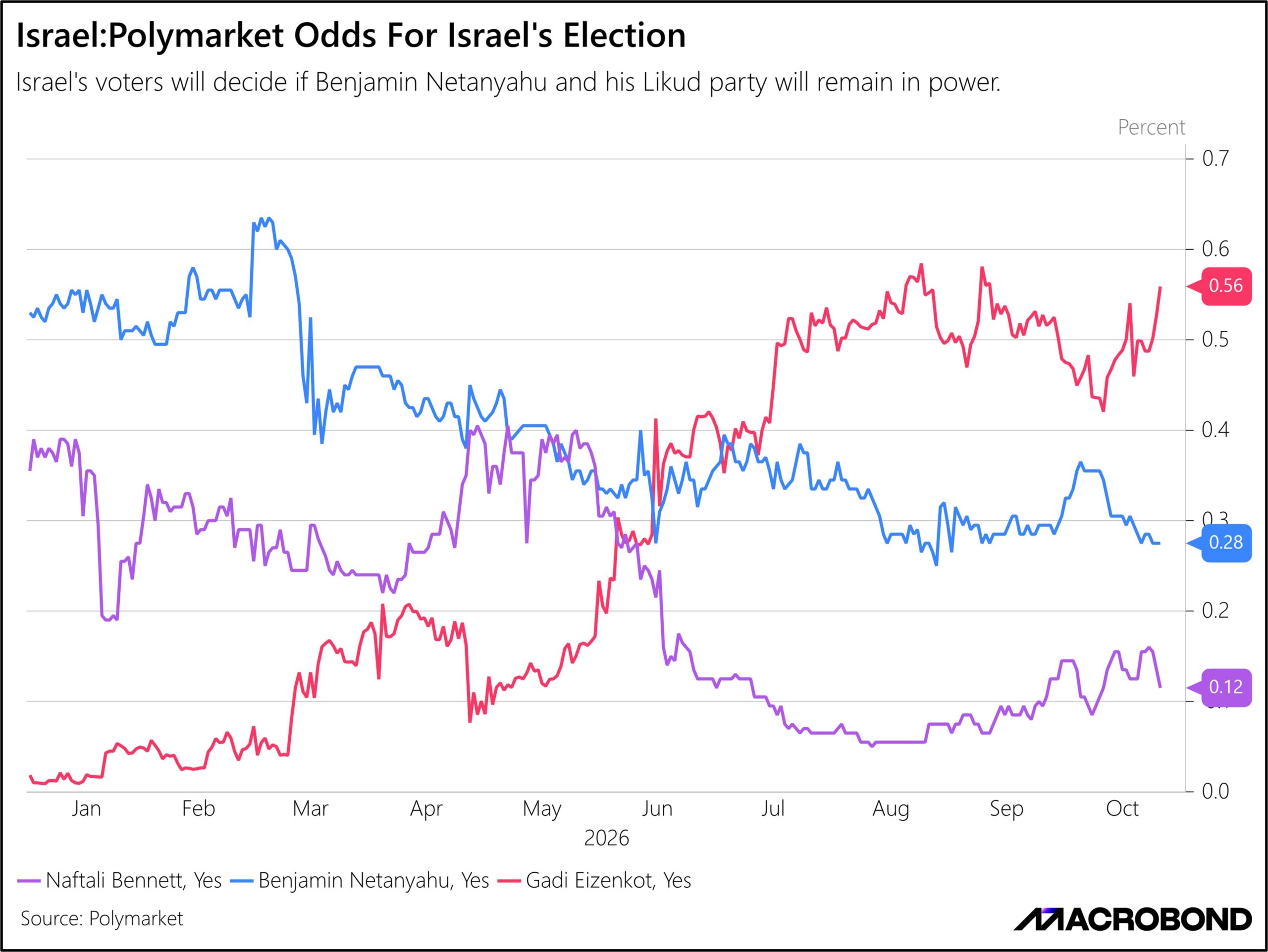
Israel: The country will vote in parliamentary elections today, with polls showing that neither incumbent Prime Minister Netanyahu nor his leading opponent, former army chief of staff Gadi Eisenkot, would likely garner enough votes to form a coalition government outright. Final results may not be available until Wednesday or even later, after which President Herzog will designate the politician who he believes has the best chance to form a government. That means it could be some time before Israel’s new prime minister is known.
France: Trying to quell the recent mass demonstrations against the cost of living and poor education services, the government yesterday offered several concessions. For instance, freshman classes at public high schools will be capped at 28 students. The government will also create 15,000 new places in universities and offer regional authorities 4 billion EUR ($4.5 billion) in loans for school renovations. Protest leaders have said the government’s proposed measures are a step in the right direction, but not enough.
- The lukewarm response from protest leaders suggests more demonstrations may be in store this coming weekend. If the political unrest continues, it will likely help bolster support for right-wing populist leader Marine Le Pen as she campaigns against the centrist establishment for the presidential election in 2027.
- The expense of the government’s promises and the threat of further political unrest may well prompt investors to continue their recent heavy selling of French government bonds, driving yields even higher.
Brazil: As expected, investors yesterday dumped Brazilian assets in response to President Luiz Inácio Lula da Silva’s surprise re-election win on Sunday. The Brazilian stock market’s main price index dropped 13.9%, while the Brazilian real plunged 8.5% against the dollar. The renewed term for Lula will probably refocus investors on his campaign promises, from debt forgiveness to increased welfare benefits, and on the country’s huge government budget deficit, which equals about 9.5% of gross domestic product.
US Monetary Policy: The Fed begins its latest two-day policy meeting today, with its decision due on Wednesday at 2:00 PM ET. Based on current interest-rate futures prices, investors are nearly unanimous in expecting the policymakers to hold the benchmark fed funds interest rate steady at a range of 3.75% to 4.00%. However, since price inflation remains uncomfortably high, we believe they will probably hike rates one or two more times in the coming months, with the next move likely coming in December.
US Elections: In a social media post yesterday, President Trump said anyone who reports an instance of voting fraud in past elections or the upcoming midterm races will be entitled to a payout of $1 million if it leads to an arrest and conviction. The president’s offer marks the most recent in a series of promised cash payouts for political support. It isn’t clear how such a program would be funded, and the offer could help generate further political controversy around the upcoming election.