


Daily Comment (September 4, 2026)
by Patrick Fearon-Hernandez, CFA, and Thomas Wash
[Posted: 9:30 AM ET] | PDF
Our Comment begins with our view on the dollar and the drivers we expect to influence it going forward. We then briefly cover the German elections, AI advances, private credit, and other market-moving narratives. We close, as usual, with a roundup of recent economic data from both the US and abroad.
The Sideways Greenback: The US dollar has remained largely flat throughout the year, even amid persistent market volatility. This stability masks a tug-of-war between several competing forces, including uncertainty over Federal Reserve policy, Japan’s suspected currency interventions, and the threat of a liquidity crunch stemming from escalating geopolitical tensions in the Middle East. While these crosscurrents have kept the greenback rangebound so far, a shift in any of these narratives could trigger meaningful moves in the dollar going forward.
- The dollar weakened against a broad basket of currencies this week, driven by diverging monetary policy signals from the Bank of Japan and the Federal Reserve. On Thursday, Fed Governor Christopher Waller pushed back against the market’s recent hawkish repricing, signaling his preference to keep rates unchanged at the upcoming meeting. At the same time, speculation that the Bank of Japan may deliver an oversized rate hike fueled a rally in the yen.
- While recent developments have weighed on the dollar, several ongoing risks could still provide support. The wars involving Iran and Ukraine remain key upside risks, particularly if either conflict escalates and drives energy and other commodity prices higher. Such a shock would likely be bullish for the dollar as it could delay Federal Reserve easing, while also increasing global demand for dollar liquidity as governments, firms, and commodity importers secure funding for essential goods.
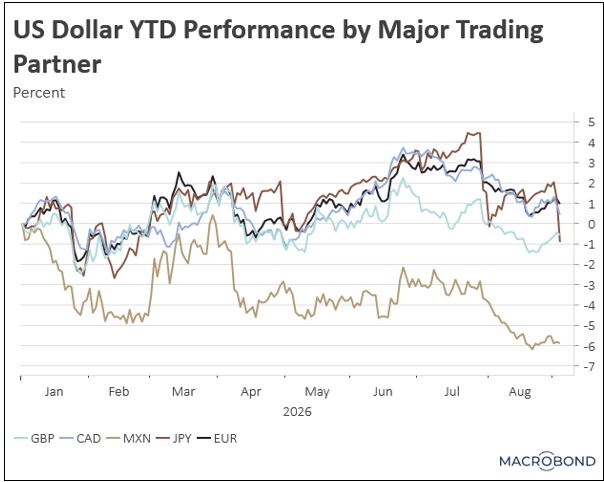
- Among the five major freely floating currencies in our basket, only the euro and Canadian dollar have weakened against the US dollar on a net basis this year. The Japanese yen has been the most volatile. It had led the declines through July before rebounding sharply, fully reversing those losses and moving into positive territory for the year. The Mexican peso has been the basket’s strongest performer, consistently holding onto the gains it made at the start of 2026.
- Monetary policy remains a key focus for currency markets, as exchange rates are highly sensitive to changes in expected interest-rate differentials. The dollar’s central role in global trade should continue to make it attractive during periods of heightened uncertainty, although we expect these episodes to provide only temporary support. Going forward, the dollar’s direction will depend largely on the relative tightness of US policy versus major peers, as well as each central bank’s credibility in maintaining price stability.
German Elections: Ahead of upcoming elections, German Chancellor Friedrich Merz has been maintaining a low profile. This decision to remain largely invisible comes as he seeks to protect his party from political backlash linked to his declining popularity during recent months. The CDU is attempting to curb the momentum of the far-right AfD in next week’s regional elections while simultaneously preparing for the general election in January. Germany — along with other European nations such as France, Italy, Poland, and Spain — is facing growing challenges from the far right.
OpenAI Breakthrough: OpenAI, the maker of ChatGPT, announced that it has developed a model it says surpasses Anthropic’s. CEO Sam Altman described the system as approaching artificial general intelligence, or AGI, a term generally used to describe AI with broad, human-level cognitive capabilities across a wide range of tasks. If borne out, such a breakthrough could strengthen OpenAI’s competitive position as it prepares for a potential initial public offering (IPO) and could provide a further catalyst for enthusiasm across the AI sector.
National AI Regulator: Meta CEO Mark Zuckerberg held a phone call with President Trump to voice concerns over the proposed oversight of AI. The discussion follows the White House’s push to establish an industry-led regulator modeled after FINRA. While the proposal has garnered backing from many tech professionals, Zuckerberg has expressed reservations and urged the president to pursue a lighter-touch approach to AI policy.
Private Credit: Cliffwater has capped redemptions in its funds to shield its portfolio from forced asset sales. Despite investor requests to redeem 16% of shares in the third quarter, the fund successfully capped redemptions at its 5% limit. While withdrawal gates often attract criticism, such measures are essential for preventing liquidity runs in otherwise high-quality assets. Notably, Cliffwater has still satisfied 78% of total redemption requests this year as outflow pressures steadily ease, a strong testament to its capacity to satisfy liquidity needs.
Norway Sovereign Wealth Fund: The sovereign wealth fund’s manager has proposed trimming its government bond holdings. The move reflects rising anxiety over meager returns amid widening deficits, inflation concerns, and geopolitical tensions. US Treasurys could bear the brunt, with potential reductions of up to $80 billion, though agency bonds appear safe given their robust performance. The broader pivot away from global debt may complicate efforts by governments to manage their swelling liabilities.