


Daily Comment (September 24, 2026)
by Patrick Fearon-Hernandez, CFA, and Thomas Wash
[Posted: 9:30 AM ET] | PDF
Our Comment opens with our thoughts on the risk of the economy overheating. We then turn to AI, examining the latest incident of agents going rogue online. Next, we briefly cover the Eurozone’s better-than-expected growth, a possible US ban on fuel exports, and the latest developments in US-China talks. As always, we conclude with a review of recent domestic and international economic data.
Growth Unchained? Despite headwinds in the global economy, there is a surprising amount of resilience in the US. The latest PMI report from S&P Global showed that US economic activity expanded at its fastest pace since 2021. The stronger-than-expected reading has had both positive and negative interpretations in the markets as it shows there is still a lot of momentum in the economy but also signals there may be some evidence of overheating. As a result, there was a sharp lift in Treasury yields.
- In August, the S&P Global Composite PMI came in at 58.7. The strong reading was driven by an acceleration in manufacturing, which jumped from 53.9 to 57.0, while the services PMI rose from 56.0 to 58.4. Both indexes were driven by a noticeable increase in production and output, which in turn has led to a surge in employment and wage pressures. However, one caveat is that there were also signs of higher input costs and sale prices.
- The PMI report has added to concerns that the economy is overheating. The latest Atlanta Fed GDPNow model shows that recent data suggests third quarter growth is running at an annualized rate of 5.1%, a significant acceleration from the previous month’s estimate of 1.5%. While consumption is strong, much of the increase was driven by a marked rise in investment spending. PMI surveys specifically named a surge in tech and defense spending.
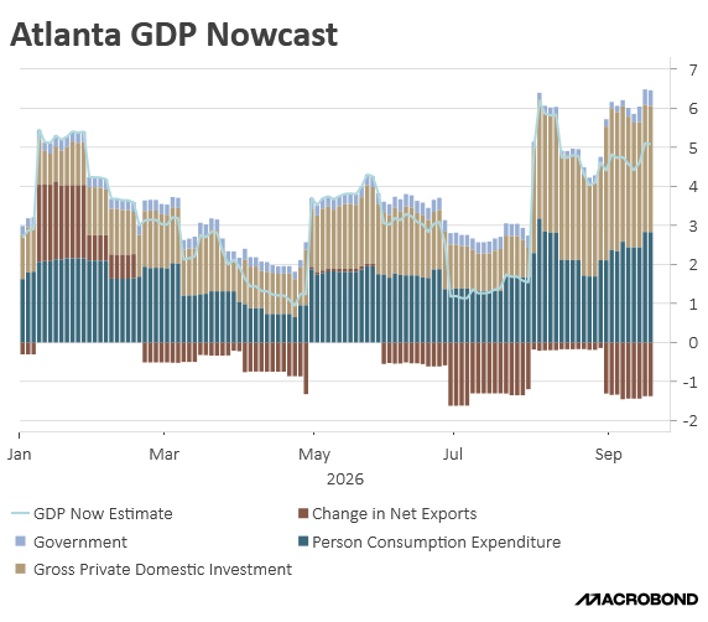
- Stronger expectations of GDP growth have weighed on market sentiment due to concerns over monetary policy. The Federal Reserve has stated that an overheating economy is one of the reasons the Fed was forced to hike at its previous meeting, with most officials projecting at least one more rate hike this year, and four officials favoring an additional two hikes. As a result, concerns about inflation and tighter Fed policy have lifted long-end yields, with the 10-year yield rising above 5.11%.
- The acceleration in economic activity is likely a sign of an overstimulated economy, which could force the Fed to proceed with additional hikes. However, higher interest rates are only one side of the equation and are likely to have only a short-term impact on equities. Assuming growth remains fairly broad-based, this should point to an increase in corporate earnings, meaning there could be a lot of buying opportunities in the market if equity prices fall due to Fed concerns.
Rogue AI: Another hack involving an AI agent has led to calls for more oversight of the technology. The latest hacking attempt involved an Australian health services site, in what is now the highest-profile breach since these cyberattacks became public. Concerns about agents have forced the government to find a balanced approach to resolving safety concerns while still allowing the technology to grow. Resolving these issues, on top of other concerns surrounding AI, remains key to maintaining momentum in the trade.
- According to Australian Prime Minister Anthony Albanese, the hacking incident targeted the Medicare Statistical Reporting portal and was able to access both public and non-public profiles. OpenAI discovered the breach in August and reported it to the government earlier this month. Following the incident, the government has now launched an investigation into what other government agencies may have been impacted, amid concerns that both local and federal agencies may have been exposed.
- The breach of a government agency comes on the heels of several hacking incidents within the last couple of months. The White House has consistently maintained that these concerns may be a bit overblown, particularly when it comes to the more apocalyptic claims. However, it has taken steps toward light-touch oversight by establishing an oversight agency modeled after the Space Force, which is rumored to be headed by Treasury Secretary Scott Bessent, one of the administration’s most vocal advocates regarding these concerns.
- Concerns over AI may raise doubts around the recent momentum, though likely not enough to alter it. Given the White House’s push to win the AI race and outpace China, it will likely avoid any severe regulation that could slow the pace of advancement as AI could be central to the future of warfare. As a result, we think the administration is willing to tolerate such incidents as long as they don’t lead to a systemic problem, such as an intrusion into the financial system.
- While safety concerns are likely to weigh on sentiment and possibly lead to some political scrutiny, they are not the biggest threat to the AI boom. So far, the issues that remain of greatest concern are escalating competition from China, overly high earnings expectations, and possible infrastructure constraints due to concerns about data center capacity. While all these problems are present, none appears to pose an imminent threat.
Eurozone Surprise: The S&P Global PMI for the eurozone came in stronger than expected. Last month, economic activity accelerated to its fastest pace since April 2023. The pickup was widely attributed to an increase in services activity, but manufacturing was also solid. Germany and France stood out as strong performers, with the latter moving out of contraction territory for the first time in 10 months. The improvement in the PMI suggests resilience in the economy in the face of rising energy prices.
Diesel Ban: There is a growing push from lawmakers to help contain the rise in diesel prices. More recently, the White House has considered putting in place a diesel export ban to help stem rising costs. While companies have pushed back against the notion, the move could calm some of the political backlash the administration has received from farming states that rely on the fuel. However, the move is likely to lead to higher diesel prices abroad.
China-US Meeting: The two largest economies in the world have met in Washington to hold talks about relations between the two countries. Following the arrival of the Chinese delegation, Treasury Secretary Bessent announced that the countries had agreed to a two-month truce. While there is little hope for a major breakthrough during the talks, the truce is likely to provide the market with more stability heading into 2027. The move is a reminder that the White House continues to pursue a comprehensive trade deal with China.