


Daily Comment (September 22, 2026)
by Patrick Fearon-Hernandez, CFA, and Thomas Wash
[Posted: 9:30 AM ET] | PDF
Our Comment today opens with increased calls for the US to ban diesel fuel exports to help bring down domestic prices. We next review several other international and US developments that could affect the financial markets today, including new signs that the war in Iran will lead to more diversified shipping options for Middle Eastern oil and news of a nascent dispute between Meta and Amazon over the use of Meta’s new Muse artificial intelligence agent for shopping on Amazon’s platform.
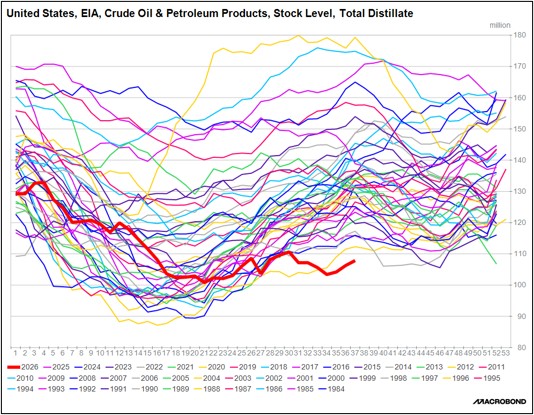
US Energy Market: As the wars in Iran and Ukraine continue to constrict global diesel fuel supplies and drive up prices, officials are reportedly considering plans to ban US diesel exports. However, since US distillate inventories are currently extremely low, we believe any such ban could have only a modest impact on prices, perhaps lowering them by no more than 10% or so. If such a ban were implemented and maintained, the more important impact would likely be to disincentivize energy investment here at home while incentivizing investment abroad.
United States-Israel-Iran: According to the Wall Street Journal, the US has proposed investing $5 billion in a new fund that would help Middle East countries rebuild energy infrastructure damaged in the Iran war and reduce their reliance on the Strait of Hormuz to transport oil and gas to world markets. The proposed bypass funding helps confirm that one key result of the war will be more diversified outbound oil shipping routes from the Middle East, which could reduce Iran’s control over the region’s waterways and help bring down prices — eventually.
- Separately, Saudi Arabian sources have reportedly said the country is making progress on repairs to its East-West oil pipeline that was damaged in fighting almost two weeks ago. The reports say that by the end of the week, oil could again flow through the pipeline for shipment through the Red Sea.
- In response, global oil prices have softened, with near Brent futures currently changing hands at $98.41 per barrel, down 1.9%.
United Kingdom-Saudi Arabia-Iran: British Prime Minister Burnham yesterday said he has approved a request from Saudi Arabia for the UK to provide military support for its fight with Iran-backed Houthi rebels in Yemen. Billing the deal as a measure to help control the cost of living and keep oil supplies flowing, Burnham said the UK will provide just one refueling aircraft to the Saudis for a limited period. Nevertheless, the step raises the risk of greater UK involvement in the US-Israeli war against Iran.
United Kingdom: Government borrowing increased more than expected to 18.3 billion GBP ($24.5 billion) in August. As a result, borrowing in the fiscal year to August has risen to a total of 77.3 billion GBP ($103.3 billion), about 8.1 billion GBP ($10.8 billion) more than the Office for Budget Responsibility’s forecast in March. The worse-than-expected deficit, which stems from both high price inflation and elevated interest rates, means public debt remains high at about 94% of gross domestic product — a rate that puts further upward pressure on UK bond yields.
China: New data from the World Gold Council shows that the Chinese central bank and other mainland buyers purchased $158.8 billion of foreign gold between January and August, bringing their total purchases to more than 1,000 tons. Coupled with recent data showing that Chinese holdings of US Treasury obligations have fallen to their lowest level since 2008, the data on gold imports suggests that both official and private investors in China are trying to diversify their asset holdings away from the US.
United States-Vietnam: As the annual UN General Assembly meetings get going in New York, Vietnamese President To Lam said in an interview that his nation is “very close” to a trade deal with the US. The president suggested that the deal will be facilitated by a Vietnamese commitment to buy more US high-technology goods, such as airliners. We suspect that any such deal would also include measures to stop Chinese producers from sending their cheap products to the US through Vietnam.
US Artificial Intelligence Industry: Meta’s share price surged 11% yesterday on news that its new Muse internet buying agent has become the top free-app download on Apple and Google. Separately, however, Amazon blocked Muse from perusing and buying products on its platform, citing concerns over customer security and user experience. Despite polls showing consumers don’t like the prospect of ever-more-powerful AI, the dispute shows that people are embracing AI agents that can help with specific tasks, setting off a clash between agent providers.
US Cryptocurrency Industry: Bitcoin prices yesterday surged to more than $87,000, up from less than $60,000 in early July. The price surge appears to have stemmed from the SEC’s unveiling last week of its “Innovation Exemption,” which opens a path for tokenized US stocks to trade on blockchain-based venues. In addition, the CFTC sent proposed crypto-market rules to the White House for review last week.
- Those moves have offset the disappointment over Congress’s failure early last week to advance the Clarity Act, which promised to provide market structure to the nascent market for crypto assets.
- The SEC and CFTC actions suggest that even if Congress doesn’t advance clear rules on crypto market structure, the administration will take regulatory steps to boost the industry.
US Homebuilding Industry: In a new poll by John Burns Research and Consulting, housing contractors around the country say ramped-up Immigration and Customs Enforcement crackdowns are creating huge labor shortages for their businesses, adding to other challenges ranging from rising mortgage rates and higher prices for key inputs to growing competition for resources from data-center builders. The result will likely be added upward pressure on home prices and reduced home sales.