


Daily Comment (September 16, 2026)
by Patrick Fearon-Hernandez, CFA, and Thomas Wash
[Posted: 9:30 AM ET] | PDF
Our Comment opens with our thoughts on the Fed ahead of today’s rate decision. We then turn to AI, examining the growing debate over regulation. Next, we cover legislation that would grant President Trump new trade authority, a meeting between US and Chinese officials ahead of their summit later this month, and the United Kingdom’s push to join a Canada-led defense bank. As always, we conclude with a review of recent domestic and international economic data.
Hawkish Sentiment: The Federal Reserve is set to deliver its rate decision later today, and the market is pricing in its first hike since 2023. Expectations of a rate hike have been increasing since the war in the Middle East started raising energy prices, leading to concerns about an uptick in inflation. While there have been worries that a hike could be the wrong move given that the source of inflation is being driven by supply factors as opposed to demand factors, questions about the Fed’s independence may mean that avoiding a rate hike could be costly.
- Sentiment has shifted regarding the Fed’s tilt over recent months after signs that the Fed was not moving closer to its 2% inflation target. Since the conflict began, the Fed has been progressively more hawkish. Although dot plots at the start of the conflict showed that FOMC members were confident in a rate cut this year, that confidence has given way to the central bank brushing aside any mention of a dovish tilt, and, at the previous meeting, a call for a rate hike from some officials.
- The shift in the FOMC has put pressure on Chair Warsh to offer some forward guidance, given that his stance has been somewhat unclear, but he has maintained the need for patience while also acknowledging the Fed’s commitment to price stability. During his comments at the Jackson Hole Symposium in August, he mentioned that the Fed “has work to do” to get inflation back to target, which has largely been seen as implicit support for a rate hike.
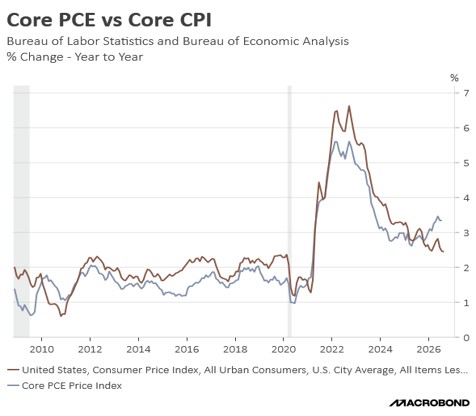
- The hawkish shift has occurred as key inflation measures have moved in opposite directions. Core CPI has edged closer to the Fed’s 2% target in recent months, while core PCE, the central bank’s preferred gauge, has moved further away from it. The divergence largely reflects differences in how the measures are weighted, particularly for housing — shelter has exerted more downward pressure on core CPI while having a much smaller effect on core PCE.
- The Fed is likely to raise rates, though we would not be surprised if it held policy steady or even opted for a larger-than-expected increase. A pause would probably reinforce the view that the committee is exercising patience in light of the conflict, while an outsized hike could help quell concerns about the Fed’s independence. As a result, today’s decision could materially reshape market expectations and set the tone for risk assets in the weeks ahead.
AI Safety Talks: There is growing discussion on Capitol Hill about how to best place guardrails for AI while also protecting against the negative consequences. On Tuesday, it was reported that a member of the Trump administration met with executives of Anthropic to discuss AI risks. This attempt to meet with business professionals comes as the White House has expressed wariness about adding restrictions that could slow the development of AI, which it views as a critical component of its national security strategy.
- White House efforts to understand the best way to guard against AI risks are fraught with growing disagreements. During a press conference in San Francisco, several tech executives argued that while the risks of AI are in fact real, the tech industry does not need new regulation. Meanwhile, at a separate conference in Washington, right- and left-wing populists Steve Bannon and Bernie Sanders agreed that there should be some oversight to prevent AI from hurting human interests.
- The discussions about what to do with AI are occurring at a time when the leading AI companies are purportedly preparing for IPOs. SpaceXAI, Anthropic, and OpenAI have all called for a global slowdown in development, despite having gone public or being prepared to do so. While these companies have continued to make promises of strong earnings power, their effort to moderate the pace of development has already been seen as a possible excuse if they fail to meet investor expectations.
- The market impact of these fears has been somewhat mild. Investors have been reducing their exposure to some chip stocks following worries that this could slow spending in the space, while software companies, which have been seen as possible casualties of the rise of AI tools, have benefited from the scare. The former may not last for long, as we think the push for the AI race is likely to benefit from government help; meanwhile, the latter’s gains may extend as AI fears continue to slow adoption rates.
- The concerns over potential guardrails have added to the fears about AI. However, its importance to US national security makes the government reluctant to offer any regulation that could prevent it from achieving its mission of eventually reaching artificial general intelligence (AGI), which would allow these models to reason and make logical decisions. This advancement would give the US a strong geopolitical advantage over its rivals.
Tariff Authority: On Tuesday, the House of Representatives advanced legislation that would give the president more authority to pursue tariffs. The proposal would allow the president to punish countries that purchase Russian energy. There is growing momentum to allow the White House more leeway in using trade and financial restrictions to prevent rivals and trade partners from going against US foreign policy and not following through on pledges.
Xi-Trump Summit: Roughly a week before President Trump is set to meet with his Chinese counterpart, both sides appear to be working to ease tensions. Treasury Secretary Scott Bessent is scheduled to meet Chinese Vice Premier He Lifeng on Sunday to discuss growing differences between the two countries, including AI development and trade. Although a major breakthrough is unlikely, the meeting could help set the tone for talks between the leaders of the world’s two largest economies.
UK Joining Canada: The United Kingdom is in discussions to join a Canada-led initiative for a defense bank. While the UK previously rejected the initial plan, it appears to have changed its tune, viewing the initiative as a potential aid in reaching its 3% of GDP defense spending target. The move is likely to further support aerospace and defense companies as Europe and other countries ramp up their military capabilities.