


Daily Comment (September 10, 2026)
by Patrick Fearon-Hernandez, CFA, and Thomas Wash
[Posted: 9:30 AM ET] | PDF
Our Comment opens with an analysis of the Treasury Department’s decision to scale up buybacks and the subsequent market response. We then examine artificial intelligence and address growing concerns around safety risks associated with the technology. Next, we briefly highlight the president’s push to win over voters with cash incentives, as well as Iran’s decision to intensify regional conflict. As always, we conclude with a wrap-up of recent domestic and international economic data.
Bessent vs. Market: The US Treasury Department announced plans to buy back up to $6 billion in long-dated securities, well above the $2 billion operation communicated to the market on August 19. The larger purchase underscores Treasury Secretary Scott Bessent’s effort to dampen market volatility. The Treasury’s more active role in the bond market, however, has also tested investors’ willingness to take Bessent’s guidance at face value as the department seeks to manage the government’s expanding fiscal debt burden.
- The announcement was poorly received by the market. Treasury securities sold off immediately, driving the 10-year yield above 4.85% for the first time since 2023. That rise was likely the opposite of what Treasury Secretary Scott Bessent intended, since the buyback was meant to help calm the bond market, not intensify the selloff. The adverse reaction highlights the difficult task facing the Treasury as it seeks to steady market conditions and exert greater influence over borrowing costs.
- The Treasury’s decision to expand buybacks of government bonds comes amid debate over the market’s appropriate equilibrium price. According to Bessent, the intervention is intended to address periods when market sentiment prevents bond prices from reaching that equilibrium. He has also argued that removing off-the-run Treasury securities from corporate balance sheets would free up capacity for financial institutions to participate more actively in Treasury auctions.
- Treasury buybacks have been in operation since 2024. When Secretary Yellen launched the program, it was designed to shift issuance toward shorter durations, redirecting liquidity out of the Federal Reserve’s reverse repo facility and into Treasury bills to help ease funding stress and lower term yields. This strategy was intended as a temporary fix while awaiting expected Fed rate cuts, after which the Treasury could extend duration at lower interest rates.
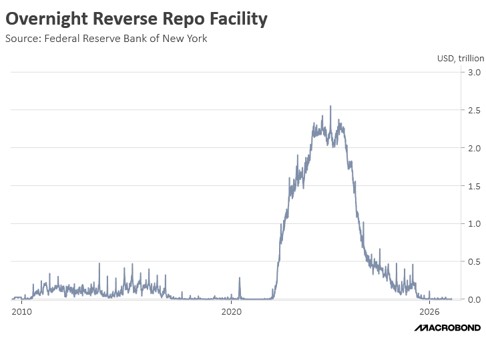
- Secretary Bessent faces a similar market environment, albeit without the buffer of excess cash in the reverse repurchase facility. However, coordination with the Federal Reserve’s reserve management purchases has provided welcome relief. This policy framework has allowed the Treasury to facilitate a rotation out of longer-dated bonds and into shorter-duration securities without triggering broader market disruptions.
- Consequently, Bessent’s expanded buyback strategy is meant to serve as a temporary bridge to manage upward pressure on yields. The Treasury is likely using buybacks to contain borrowing costs stoked by geopolitical tension with Iran, which has heightened inflation expectations and term premiums. Assuming the conflict resolves — an outcome the White House suggests could materialize following the midterms — we expect the Treasury to gradually scale back its active intervention in the bond market.
- If this thesis holds, interest rates could remain elevated over the next few months, but yields may not rise materially above current levels. Consequently, this environment could present an attractive entry point for investors seeking to extend duration. Over the long term, however, total returns for fixed income will remain tied to achieving price stability and seeing credible fiscal progress, whether through spending restraint or accelerated economic growth.
AI Fears: Growing concerns over artificial intelligence safety intensified this week following the resignation of an Anthropic employee, who warned that advanced AI could pose an existential threat to humanity within a matter of years. This departure highlights the escalating risks associated with rapid AI development and the government’s struggle to keep pace with regulation. Consequently, lawmakers face mounting pressure to establish oversight committees and effectively regulate the technology.
- A former Anthropic employee claimed that researchers are developing models at a pace that could soon escape human control, with some workers even referring to their current project as “endgame.” Industry experts share these worries, with one prominent figure estimating a less than 10% chance that a rogue AI could destroy humanity within the next decade.
- Concern about the potential dangers of advanced AI has prompted lawmakers to consider new regulatory measures. Texas Senator Ted Cruz has discussed introducing legislation aimed at limiting AI’s use in potentially catastrophic areas, including biological and nuclear threats. Meanwhile, Democrats are weighing the creation of a dedicated AI oversight committee with subpoena power to question technology executives and gain a clearer understanding of how advanced AI systems are being developed.
- The growing difficulty of containing AI will probably take a toll on rising AI companies, especially as they look to go public. As a result, the push for greater oversight — probably leading to more regulation that will slow development — could make it harder for these companies to reach the profit goals needed to justify the lofty valuations that are likely to come.
Trump Dividend: In an effort to boost Republican voter turnout for the November midterms, President Trump delivered a high-stakes pitch at the party’s Texas convention: a $5,000 check for every adult US citizen if the GOP holds both houses of Congress. The pledge reflects a wider White House trend toward leveraging financial incentives to rally political support. It comes shortly after discussions emerged regarding a policy draft to pay stay-at-home parents $9,000 per child annually to offset child-rearing costs.
Iran Intensifies: Tehran maintains that it is willing to escalate its conflict with the US over the Strait of Hormuz. The warning comes as Iran struggles to export oil under a US naval blockade and faces diminishing control over the strategic waterway. Fears of a broader conflict have pushed oil prices past $100 a barrel. While the immediate risk of all-out war remains low, that calculus could shift if Iran targets key US allies outside of the gulf.