


Daily Comment (October 9, 2026)
by Patrick Fearon-Hernandez, CFA, and Thomas Wash
[Posted: 9:30 AM ET] | PDF
Our Comment opens with concerns surrounding AI companies and their ability to meet soaring investor expectations. We then turn to geopolitics, examining the US-China AI race and its broader diplomatic fallout. Next, we briefly cover Italy’s recent electoral reform, provide an update on US-Iran relations, and examine the Treasury’s appointment of a controversial former Fed nominee. As always, we conclude with a roundup of key domestic and international economic data.
AI Concerns: As major AI labs prepare to go public, investors are once again questioning their valuations. On Thursday, OpenAI reportedly projected $20 billion less annualized revenue than investors had anticipated. This shortfall has added to market jitters and sparked fresh speculation about a bubble, even as the broader impact of the AI boom becomes increasingly evident across the economy. While the miss probably won’t deter these companies from going public, it is likely to raise concerns about the viability of the AI boom.
- OpenAI recently told investors it expects to report annualized revenue of $50 billion at the end of September, well below the roughly $70 billion figure reported earlier. The earlier number rested on a reported 70% jump from a $40 billion annualized rate in July, a baseline the company has since revised to $30 billion in an updated presentation. This discrepancy comes as investors have sought to make OpenAI’s figures comparable with those of its rival Anthropic, which calculates revenue differently.
- Doubts about the company’s figures come as it and its rival Anthropic prepare to go public. Both companies are looking to the equity market to help fund the infrastructure needed to serve customers and train their models. They have also come under scrutiny because their expenses far exceed their revenue, raising worries that the two companies are building faster than demand can justify.
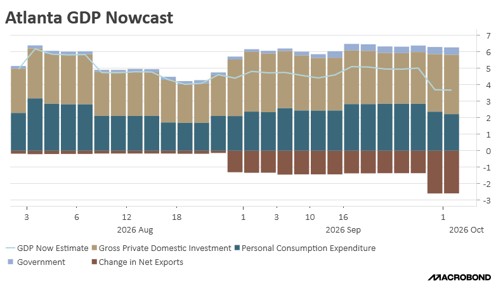
- Spending by AI companies and the hyperscalers has been a key source of support for the economy. Business investment, much of it driven by AI, is projected to account for more than half of GDP growth in the third quarter of 2026, according to the Atlanta Fed’s latest GDPNow estimate. The AI investment boost is expected to keep economic growth above its potential through 2028.
- OpenAI’s revenue miss may simply be an error, but it could also signal that demand is not as strong as hoped. While this alone is unlikely to end the boom, it could lead to a slowdown in investment, which could then weigh on overall sentiment. However, we think the slowdown would likely benefit the sector, as companies that build too fast typically create overcapacity, which undermines their prospects for long-term profitability.
AI Race: The competition for AI supremacy between the US and China is intensifying. On Thursday, reports revealed that Beijing is accelerating its nationwide data center expansion to satisfy surging demand for computing power. Meanwhile, Washington is moving to secure critical mineral supply chains to reduce foreign dependencies. These parallel pushes underscore how direct government intervention is reshaping markets as both superpowers champion domestic tech leaders on the global stage.
- China is actively building data center hubs to link its energy-rich regions with high-demand urban centers. Under its “Eastern Data, Western Computing” initiative, Beijing is constructing major computing facilities in the country’s resource-abundant western provinces to avoid driving up land and electricity costs in the densely populated east. This nationwide push aims to close the gap with the US, which currently leads global data center capacity with roughly 56 gigawatts compared with China’s 24 gigawatts.
- At the same time, the US is making strides toward securing the critical minerals essential for the AI expansion. The federal government continues to back domestic resource development to reduce its reliance on Beijing. On Thursday, Houston-based Hertha Metals announced that it is nearing commercial production of high-purity iron — a key component in tech-grade permanent magnets. This progress aligns with broader US efforts to stockpile strategic materials following recent Chinese export restrictions.
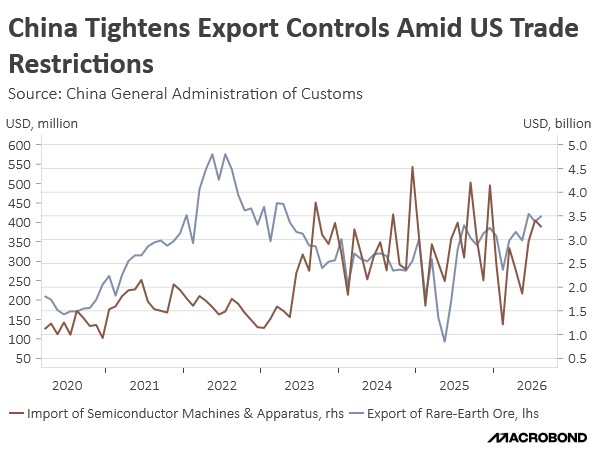
- This intensifying rivalry reflects a delicate balancing act as both nations attempt to compete while maintaining a peaceful coexistence. Although China faces fewer supply chain bottlenecks for its data center expansion, it still lacks the sophisticated equipment required to take a decisive lead. Meanwhile, US energy constraints and critical resource shortages make it difficult for Washington to pull further ahead. As a result, both superpowers are still tethered by mutual dependencies.
- The economic decoupling between the US and China will probably happen much more slowly than many anticipate. Although both superpowers wish to operate independently, they remain deeply reliant on each other’s supply chains. Nevertheless, as they gradually break away, both nations are expected to stockpile critical AI resources — a trend that could drive up global commodity prices. Consequently, the ongoing AI buildout could introduce persistent inflationary pressures worldwide.
Meloni Win: Italy’s parliament approved Prime Minister Giorgia Meloni’s proposed electoral overhaul, shifting to a proportional representation system with a 42% majority bonus. Designed to streamline government formation and prevent post-election deadlock, the law grants winning alliances additional seats to secure a functional majority in both houses. The legislative win restores political momentum for Meloni following the defeat of her earlier judicial reform referendum.
Attack Off? President Trump has ruled out the possibility of attacking Iran before the midterm elections. His decision to pause military action follows recent “productive” diplomatic talks between Washington and Tehran. Additionally, political considerations appear to be playing a significant role, as Republicans struggle to maintain control of Congress amid public backlash over rising oil and gasoline prices driven by the conflict.
Treasury Hires Outsider: The Treasury has appointed economist Judy Shelton as a currency policy adviser. Her 2019 nomination to the Federal Reserve was blocked due to concerns over her political objectivity and conflicting economic views — specifically, her advocacy for easy monetary policy despite her historical preference for restrictive frameworks. Her appointment underlines the Treasury’s interest in rethinking financial strategy to increase resilience against foreign competitors.