


Daily Comment (October 23, 2026)
by Patrick Fearon-Hernandez, CFA, and Thomas Wash
[Posted: 9:30 AM ET] | PDF
Our Comment opens with our takeaways on the upcoming midterm elections. We then turn to fixed income and examine the recent rotation out of tech stocks and into bonds. Next, we briefly cover rising friction between the US and Canada, as well as Anthropic’s plans to expand its business into Europe. As always, we conclude with a review of recent domestic and international economic data.
Midterm Jitters: A little over 10 days ahead of the midterm elections, market indicators and polling models suggest a growing likelihood of a Democratic wave. According to Polymarket, odds favor Democrats sweeping both chambers, with a nearly 70% probability. Meanwhile, projections from RealClearPolling favor Democrats in the House while indicating a much tighter Senate contest, where each party is projected to win 46 seats and eight races are toss-ups. Though consensus is currently leaning toward a sweep by the Democrats, historical volatility suggests a Senate upset is still entirely possible.
- A Democratic takeover of the Senate remains far from guaranteed. To capture the chamber, Democrats would need to win at least five toss-up seats — a steep challenge. According to tracking from RealClearPolling, eight states are currently designated as toss-ups: Texas, Ohio, Kansas, Alaska, Iowa, Michigan, Minnesota, and Maine. Half of these states have historically leaned Republican or continue to be GOP strongholds, while two of the remaining four seats are currently held by Republican incumbents.
- Additionally, while prediction markets are still confident, actual polling points to much closer races. According to Polymarket odds, Kansas is the only state among those mentioned that leans Republican, with Iowa still the lone toss-up. In contrast, polling data from RealClearPolling shows five key states — Texas, Iowa, Kansas, Minnesota, and Maine — are separated by an average of two percentage points or less, placing them well within the margin of error.
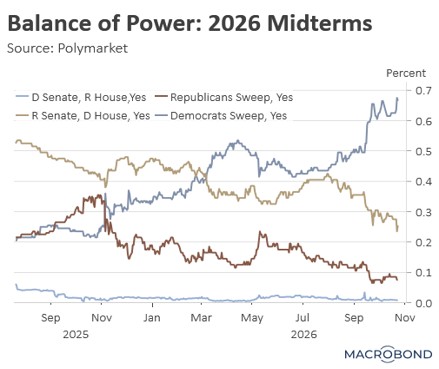
- While control of the Senate remains in play, the House race appears to lean toward Democrats, who are expected to secure a majority of the 435 seats, according to polling averages and prediction markets such as Polymarket. RealClearPolling projections suggest Democrats could win up to 237 seats, while Polymarket gives the party an 80% chance of securing at least 230 seats. Taking control of at least one chamber would give Democrats a significantly stronger foothold in shaping legislative policy.
- A return to Democratic control in either chamber would likely bring added political theater, but it could also foster greater consensus-building. Over the past two years, fierce debates over fiscal and foreign policy have heightened partisanship given the narrow congressional margins. However, a divided Congress could empower moderate lawmakers to bridge the political divide, potentially opening the door to pragmatic policy solutions on the national debt, trade, and foreign conflicts.
Bond Returns: Tech sector anxieties have driven investors back into US Treasurys. Over the past few weeks, there has been speculation that the massive AI buildout has started to compete directly with sovereign debt for safe-haven status. As market jitters over CoreWeave’s debt load raise broader questions about the sustainability of the AI boom, demand for government bonds has surged. This trend suggests that despite mounting concerns over the national debt and inflation, Treasurys may remain attractive for investors.
- The latest market fears were reignited by Meta’s recent earnings report. On Thursday, the Facebook parent company posted strong results, beating revenue estimates while announcing plans to further increase capital expenditures for its infrastructure buildout. The move raised fresh concerns that Meta is expanding data centers too quickly and relying too heavily on debt. Following the announcement, Meta’s bond prices weakened, and its credit spread widened.
- Growing anxiety over AI spending comes as the corporate bonds used to finance the infrastructure expansion begin to saturate the credit markets. Over the past few months, traditionally cash-rich tech giants and their partners have amassed over $500 billion in debt. This surge in borrowing has strained the financial system, forcing companies to syndicate their loans across multiple lending institutions to secure sufficient capital.
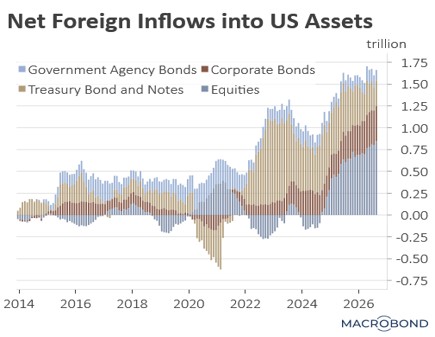
- The massive scale of the AI buildout may be directly affecting the US government debt market as AI-linked assets emerge as formidable competitors for capital. Recent Treasury International Capital (TIC) data shows foreign investment flows shifting away from US Treasurys and toward US corporate bonds and equities. While the report does not pinpoint the exact destinations of these funds, the reallocation closely coincides with the latest surge in demand for AI-driven tech assets.
- Fears of an AI bubble bursting could spark a rotation into US Treasurys. A market pullback in AI would not only eliminate a key equity competitor for capital but also temper inflation concerns. A sector slowdown would curb demand for data center inputs while leaving surplus capacity for companies to leverage. That said, the exact timing of any market adjustment remains highly uncertain.
Northern Border Friction: Washington has accused Ottawa of election interference just days ahead of the US midterms by alleging that Canadian retaliatory tariffs were designed to sway voters. While Canada insists the duties are purely economic defenses for domestic industries, Ottawa has directed diplomats to avoid US political figures until the midterm voting concludes. The growing rift risks stalling the upcoming bilateral trade negotiations.
Europe Adopts AI: Anthropic has agreed to support the creation of a European consultancy aimed at expanding corporate AI adoption. By placing AI specialists directly within businesses, the initiative will help European firms integrate model capabilities into their operations. While the move poses a competitive threat to traditional consulting firms, it creates a lucrative new revenue stream for AI developers seeking to justify heavy capital expenditures and enter new regional markets.