


Daily Comment (October 15, 2026)
by Patrick Fearon-Hernandez, CFA, and Thomas Wash
[Posted: 9:30 AM ET] | PDF
Our Comment begins with our thoughts on speculative AI debt. Next, we discuss growing signs that inflationary pressure is building in the economy. We then briefly cover the new ways that hyperscalers are getting communities to sign off on data centers, as well as the push by the White House to restart peace talks between Russia and Ukraine. As always, we conclude with a roundup of key domestic and international economic data.
AI Concerns: The market is beginning to show uneasiness regarding debt quality for companies tied to the AI infrastructure buildout. CoreWeave has become the latest to face scrutiny, with its debt falling into distressed territory. These rising fears over AI-related debt have triggered a rotation out of speculative bonds and into government debt as investors seek safer alternatives. Though this sentiment shift currently appears limited to a handful of companies, it could indicate a broader market trend ahead.
- CoreWeave’s weakness stems from concerns over its balance sheet as investors begin to price in a potential AI slowdown. As a specialized cloud provider, CoreWeave generates revenue by equipping data centers with Nvidia GPUs (Nvidia is also an investor) and renting out compute power to AI labs. Although demand for its services has surged, the company has taken on substantial debt alongside rising operational costs, raising questions about the sustainability of its rapid expansion.
- While CoreWeave remains the focal point, credit risk is spreading across the AI space. In recent weeks, credit default swap (CDS) spreads have widened for Oracle and SpaceX as investors gauge potential friction in the AI expansion. Five-year default probabilities derived from current CDS pricing sit at nearly 50% for CoreWeave, 20% for Oracle, and 16.5% for SpaceX, far above the 3% historical average for speculative-grade debt.
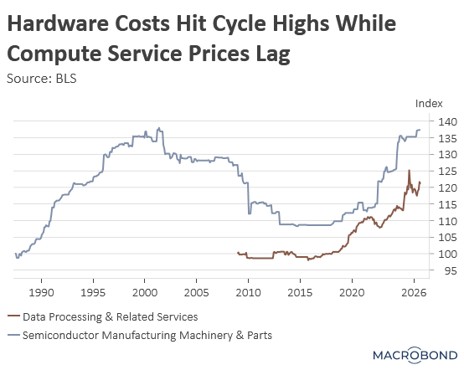
- The weakness in the AI trade comes as companies grapple with the rising costs of AI hardware, elevated borrowing rates, and declining compute prices. Following years of steady decline, semiconductor equipment costs have spiked to levels not seen since the dot com bubble. At the same time, higher government debt yields have pushed up corporate borrowing costs, making debt loads increasingly unsustainable, while cloud providers face growing pressure to cut prices to stay competitive.
- Beyond AI itself, credit markets are still our primary focus. If a moderation in AI investment results merely in a reduction of capital expenditure, the broader economy should remain resilient. However, if rising credit stress triggers a tighter lending environment across other sectors, the fallout could extend well beyond technology. So far, the evidence points to the former. If that holds true, it could even benefit AI labs, as excess capacity would likely push down compute prices.
Inflation Worries: Signs of mounting price pressures have fueled speculation that the Federal Reserve could raise rates again this month. The latest Beige Book reported a pickup in inflation across several districts, while September’s CPI report showed prices rising faster than expected. Together, the data has raised concerns that the Fed may be falling behind the curve on inflation heading into its October 27-28 meeting. Fed officials, however, continue to send mixed signals about their next policy decision.
- Half of the Federal Reserve’s 12 districts reported robust or intensifying price pressures in recent weeks. Some contacts across the districts cited higher oil and diesel prices, whereas others pointed to rising costs for other commodities, as well as tariffs and insurance. Firms also said higher input costs were squeezing margins, and some indicated a willingness to pass those costs on to consumers as they navigate heightened uncertainty.
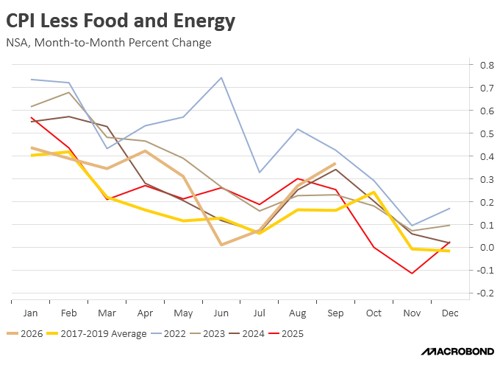
- September’s CPI reflected similar inflation pressures. Headline CPI accelerated to 0.6% month-over-month from 0.4% in August, while the core index rose 0.3% for a second straight month. Both readings came in slightly above market expectations, and both were well above their pre-pandemic norms. In fact, on a non-seasonally adjusted basis, core CPI posted its highest September reading in over four years.
- While inflation continues to be a problem, a Fed hike is far from certain. For one, even though growth has been robust, there are indications that it isn’t being felt across the entire country. According to the Beige Book, seven of the 12 districts reported only slight or no growth in economic activity since the last report. Additionally, job gains, while better than last year, are still relatively sluggish, suggesting that firms may be feeling the effects of previous tightening.
- As the Fed heads into the blackout period this weekend, it continues to be unclear which way policymakers will lean. While most Fed officials appear to back at least one more rate hike this year, whether it comes in October or December remains up in the air. Markets now price roughly even odds of a hike this month after the September CPI report sharply raised expectations. Further Fed tightening would likely weigh on bond prices.
Tech Pays Up: Data center developers are evaluating direct cash incentives for local residents to ease community opposition. In Kansas, a real estate firm has partnered with major technology companies to offer households $1,000 annually over a 10-year period in exchange for supporting local development. The initiative comes as developers seek innovative strategies to overcome mounting public pushback against large-scale infrastructure projects.
Russia-Ukraine: The US is making renewed diplomatic efforts to bring Russia and Ukraine to the negotiating table. Recently, the White House floated to European allies the idea of unfreezing Russian assets to help restart talks. However, the proposal was met with minimal support from the European Union, which remained skeptical of its effectiveness. The initiative has raised fresh concerns about the long-term US commitment to Ukraine, particularly as both Russia and Ukraine continue to target each other’s energy infrastructure amid already elevated prices.