


Daily Comment (October 14, 2026)
by Patrick Fearon-Hernandez, CFA, and Thomas Wash
[Posted: 9:30 AM ET] | PDF
Our Comment opens with an update on the escalating conflict in the Middle East, particularly as Saudi Arabia becomes more deeply involved. Next, we discuss how Fed officials continue to keep forward guidance alive even as the Fed chair tries to do away with it. We then briefly cover Fed Governor Lisa Cook’s decision not to attend a hearing, as well as the global pressure on Putin to join an energy truce. As always, we conclude with a roundup of key domestic and international economic data.
Broadening Conflict: The war in Iran continues to show signs of spreading across the Middle East. This week, the Houthis stepped up their attacks on Saudi Arabia, while Iran intensified its attacks on ships transiting the surrounding waterways. The escalation marks a sharp rise in regional tensions that has continued to push energy prices higher worldwide. However, while the conflict has added to price pressures, it is important to remember that not all regions will necessarily be affected equally.
- Saudi Arabia is being drawn deeper into the conflict as Houthi attacks target major cities, including Riyadh, hitting both civilian areas and critical energy infrastructure. To counter these threats, the kingdom has relied on a coalition of member states to help repel incoming strikes. This escalation comes as Saudi Arabia actively seeks alternative export routes to ship oil and relieve global supply strains caused by the conflict with Iran.
- Simultaneously, Iran has escalated its maritime operations. To sustain pressure on the Strait of Hormuz despite having its primary radar infrastructure destroyed by US strikes, Tehran adapted its strategy by relying on unarmed spotters to maintain surveillance and target identification for the Islamic Revolutionary Guard Corps. This tactical pivot has driven the sharpest increase in commercial tanker attacks since the war began in February.
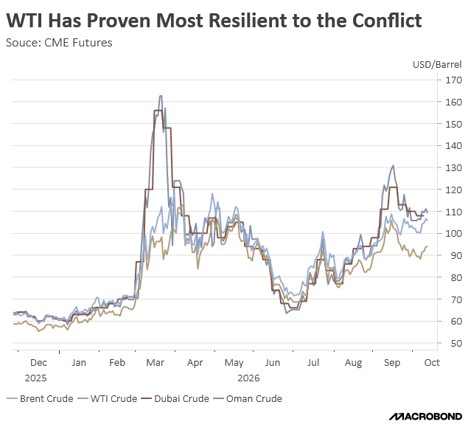
- Iran and its partners are escalating attacks, adding to upward pressure on oil prices and weighing on US voter sentiment. However, the US oil market has been relatively sheltered from the disruption. WTI is trading at a substantial discount to its competitors, reflecting domestic supplies’ lower direct exposure to shipping risks in the Middle East. Meanwhile, US exporters still face soaring freight costs, making their crude more expensive to deliver overseas and helping sustain that discount.
- The recent escalation in the Middle East may reflect Iran’s desire to pressure the White House ahead of the midterm elections. Tensions could ease after the vote, when Tehran has a clearer sense of its negotiating leverage. Such an outcome would likely support US equities, but foreign markets, particularly those more exposed to higher energy costs, could offer greater upside if oil prices retreat.
Forward Guidance? While Fed Chair Kevin Warsh has been reluctant to offer insights into the central bank’s next moves, other FOMC members have been more vocal. On Tuesday, New York Fed President John Williams stated that he does not see a need for a rate hike in 2027. His remarks suggest that the rate-hiking cycle may be significantly shorter than markets currently price in. If so, this could provide much-needed relief for bond markets, which are presently under pressure on multiple fronts.
- Williams explained that while he has not ruled out another rate hike this year, he sees a path for inflation to decline next year. He noted that inflation could ease significantly toward the Fed’s 2% target as the effects of tariffs and energy shocks begin to roll off. This cooling, along with easing stress in other areas, should help offset price increases driven by the ongoing AI buildout.
- Williams’ commentary on the rate path follows similar remarks from other Fed officials. Cleveland Fed President Elizabeth Hammack, a voting member this year, advocated for returning interest rates to restrictive territory to contain inflation. Meanwhile, Richmond Fed President Tom Barkin, an alternate voter this year who becomes a full voting member next year, also maintained that monetary tightening could occur before the end of the year.
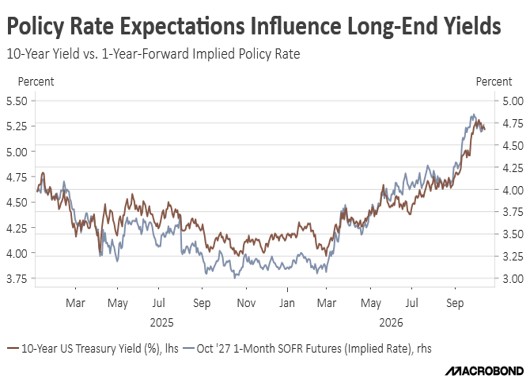
- Expectations surrounding Federal Reserve policy remain a primary driver of rising long-duration bond yields. The Fed’s more hawkish posture has significantly influenced long-term rates, helping push the 10-year Treasury yield to its highest level since 2002. Since the Fed’s September FOMC meeting, at which officials raised rates for the first time since 2023 and the dot plot signaled at least one further hike this year, the 10-year yield has risen roughly 30 bps.
- Although Chair Warsh has been reluctant to offer forward guidance, markets have been able to read signals from the rest of the committee. This increased communication could reduce some of the volatility in the bond market. That said, recent remarks from Fed officials suggest they still favor at least one more hike, while the path in 2027 remains uncertain. Signs of dovishness could weigh on bond yields over the coming months.
Fed Pressure: Fed Governor Lisa Cook will not attend a November 5 White House hearing on allegations of mortgage fraud. Her attorney said that Cook will be in Europe that day on official business at financial and monetary policy meetings, and any hearing would need to take place no earlier than the conclusion of the December 8-9 FOMC meeting in order to allow time to prepare. The inquiry is the White House’s latest attempt to remove Cook from the Federal Reserve Board; so far, she has not been charged with a crime.
Ukraine Ceasefire: German Chancellor Friedrich Merz and Ukrainian President Volodymyr Zelenskyy have requested that Russia agree to an energy truce. The move follows US President Donald Trump’s announcement of a diesel deal with Russian President Vladimir Putin, which included an agreement that Russia and Ukraine would refrain from attacking each other’s energy infrastructure. However, the deal quickly collapsed when neither side formally acknowledged the arrangement, leading Russia to strike a Ukrainian oil refinery and prompting Ukraine to retaliate in kind.