


Daily Comment (October 1, 2026)
by Patrick Fearon-Hernandez, CFA, and Thomas Wash
[Posted: 9:30 AM ET] | PDF
Our Comment opens with our thoughts on whether the unwinding of the yen carry trade may be contributing to rising bond yields. We then turn to monetary policy where we examine White House efforts to push former Fed Chair Jerome Powell out of the central bank. Next, we briefly cover a potential partnership between the EU and Canada, South Korea’s planned investment in Alaska, and a failed Senate effort to make data centers pay for their own grid costs. As always, we conclude with a review of recent domestic and international economic data.
The Yen Carry Threat? The yen may be playing a bigger role in the global bond market than investors realize. While the market has attributed the recent rise in global bond yields to the war in the Middle East and the AI boom, noted economist Ed Yardeni points instead to an unwinding of the yen carry trade driven by rising Japanese policy rates. If he is right, his theory may help explain why the US Treasury has intervened in both the currency and bond markets and offer clues as to where yields may head next.
- Earlier this week, Yardeni suggested that a potential catalyst for the rise in bond yields was the Bank of Japan’s decision to raise its policy rate above 1% for the first time since 1995. In his view, the hike set off a structural unwinding of the yen carry trade, in which investors borrow cheaply in yen and invest the proceeds in higher-yielding assets abroad. The trade has been a cornerstone of global markets and a key source of liquidity for years, but that role may now be at risk as Japan tightens policy to curb inflation.
- Recent actions by the US Treasury Department also suggest a possible connection. This year, the department has coordinated with Japan on yen support operations, including open-market purchases of the currency, and it has also conducted buybacks of US government debt. Treasury Secretary Scott Bessent’s suggestion that he possesses nonpublic information about the outlook for the yen and bond markets may further signal his intent to prevent a disorderly unwinding of the carry trade.
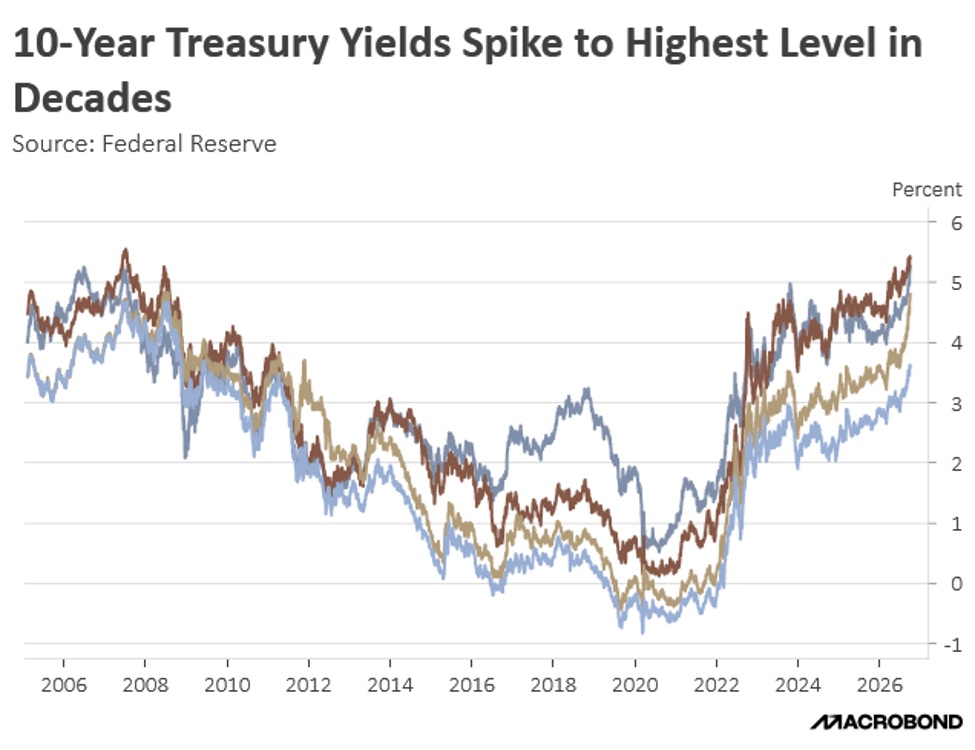
- The potential unwinding of the yen carry trade may be more of a global story than a US one. The US 10-year Treasury yield has risen roughly 80 basis points, while 10-year gilt, Bund, and OAT yields have also increased materially. The breadth of these moves suggests the yen carry trade may have helped keep global bond yields low, and its unwinding may now be contributing to a global bond sell-off.
- If the rise in global bond yields partly reflects an unwinding of yen-funded carry trades, then bond markets could become increasingly sensitive to further Bank of Japan tightening. Conversely, a slower pace of BoJ normalization could provide some near-term relief by easing pressure to unwind those positions. However, other factors, including Middle East tensions, rising debt burdens, and the risk of overheating from the AI buildout, will also likely play an important role.
Fed Pressure: In its ongoing effort to shape central bank policy, the White House directed Attorney General Todd Blanche to review a report clearing former Federal Reserve Chair Jerome Powell. On Wednesday, the Fed’s internal watchdog finalized its review of the headquarters renovation, finding no evidence of criminal intent or misconduct. The move underscores the administration’s persistent push to counter what it sees as political bias at the Fed.
- The decision to scrutinize the watchdog’s findings follows the report’s highlight of significant management deficiencies. According to the evaluation, key missteps, including proceeding well into construction without a total cost estimate or a guaranteed maximum price, drove the renovation’s total cost from $1.3 billion to $2.4 billion. Despite these operational failures, the report concluded there was no evidence of administrative misconduct or federal criminal violations.
- While the report likely falls short of providing the president legal grounds to fire Powell or force him off the Federal Reserve Board, the administration appears undeterred. Following the report’s release, the president argued that former Fed Chair Powell remains responsible for the cost overruns. Consequently, he has directed Attorney General Blanche to explore whether the government can hold Powell accountable through the courts, potentially via a civil lawsuit.
- White House pressure to remove Powell likely underscores its broader intention to replace Fed officials it does not trust. Over the past two years, it has targeted former Chair Jerome Powell, Governor Lisa Cook, and former Vice Chair for Supervision Michael Barr. Removing them would create additional opportunities to appoint officials more aligned with the administration’s agenda, including a potentially greater willingness to delay or soften monetary tightening.
- Although previous White House pressure on the Fed has weighed on the dollar, market sentiment appears to have shifted since the Fed raised rates in September. The dollar’s muted response suggests that investors have greater confidence in the central bank’s willingness to set policy independently of political influence. As a result, future White House attacks on the Fed could have a smaller effect on markets.
EU-Canada: The European Union and Canada are expected to unveil a broad new partnership at their summit next month. The agreement is expected to cover digital trade barriers and critical raw materials as well as joint support for Ukraine. A deal would deepen ties between the two sides as they seek to reduce their dependence on the US and strengthen their leverage in trade negotiations with Washington. The move could provoke a backlash from the White House against the EU as the president has viewed other similar actions as meddling.
Alaska Investment: President Trump announced plans for South Korea to invest in a liquefied natural gas project in Alaska. The move comes as South Korea seeks to meet its investment commitments under last year’s trade agreement with the US. While no timeline has been set for the project and the funds have not been formally approved, the announcement suggests the US economy could see additional investment from reshoring efforts following the trade talks.
Data Centers: The US Senate failed to advance legislation that would encourage data centers to bear the cost of the grid upgrades needed to serve them. Lawmakers who voted against the measure said it did not go far enough, since it would not require data centers to cover those costs. However, the failure has also been attributed to Democrats’ reluctance to hand a vulnerable Republican senator a win ahead of the midterms. The broad support suggests that data centers could face rising costs in 2027.