


Daily Comment (May 18, 2026)
by Patrick Fearon-Hernandez, CFA, and Thomas Wash
[Posted: 9:30 AM ET] | PDF
Our Comment today opens with a short review of the US-China summit in Beijing late last week. We next review several other international and US developments that could affect the financial markets today, including a potential labor strike at South Korean semiconductor giant Samsung Electronics and new signs that the US may still be interested in a military strike against Cuba despite the stalemate in the US-Israeli war against Iran.
United States-China: Now that the latest summit between President Trump and General Secretary Xi has wrapped up, it seems that the meeting produced little value for the US beyond generally positive optics and commitments on both sides to ease tensions. Details are still dribbling out, but it appears that no major deals were struck for China to pressure Iran to end its effective shutdown of the Strait of Hormuz, stop its predatory economic and technology policies, ease its military pressure on Taiwan, or respect other major US interests.
- In trade, the Chinese Commerce Ministry on Saturday said Beijing has committed to cutting import tariffs on some US products and explore increased purchases of US farm products and other goods. However, official statements so far suggest the commercial deals were more modest than expected. Of course, China also has a history of failing to fully implement such deals. In sum, the summit appears unlikely to usher in significant new US trade with China.
- Regarding key national security issues, there was no apparent deal for China to step back from its military, economic, and diplomatic pressure on Taiwan and its effort to set the stage for an eventual seizure of the island. Indeed, Trump downplayed US military and economic interests related to Taiwan and suggested the US military might not have the capability to defend the island.
- While President Trump appears to have banked on establishing warm personal ties with Xi, even that effort appears to have failed. While the US president repeatedly referred to Xi as his “friend,” the Chinese leader and his administration made no apparent effort to say the same thing about Trump. Indeed, it appears that the Chinese side deliberately took steps to undercut the US president’s status. For a photo, for instance, the Chinese had Trump sit in a low-slung chair so that it appeared he was smaller than Xi.
Global Semiconductor Industry: Korean semiconductor giant Samsung Electronics and its biggest union are meeting today in a last-ditch effort to avert a strike. Now that Samsung is reporting record profits because of the global artificial intelligence boom, its workers are demanding increased wages and benefits. The union has set a May 21 deadline for a deal, or it will stage an 18-day walkout.
- Of course, a strike could potentially hurt not only Samsung, but it could potentially disrupt supply chains related to global AI investment.
- Nevertheless, Samsung shares have risen sharply today after a South Korean court granted Samsung’s request for an injunction that will limit the impact of the strike. Under the injunction, staffing levels needed for safety protection, facility damage prevention, and product quality maintenance must remain at normal levels during the strike.
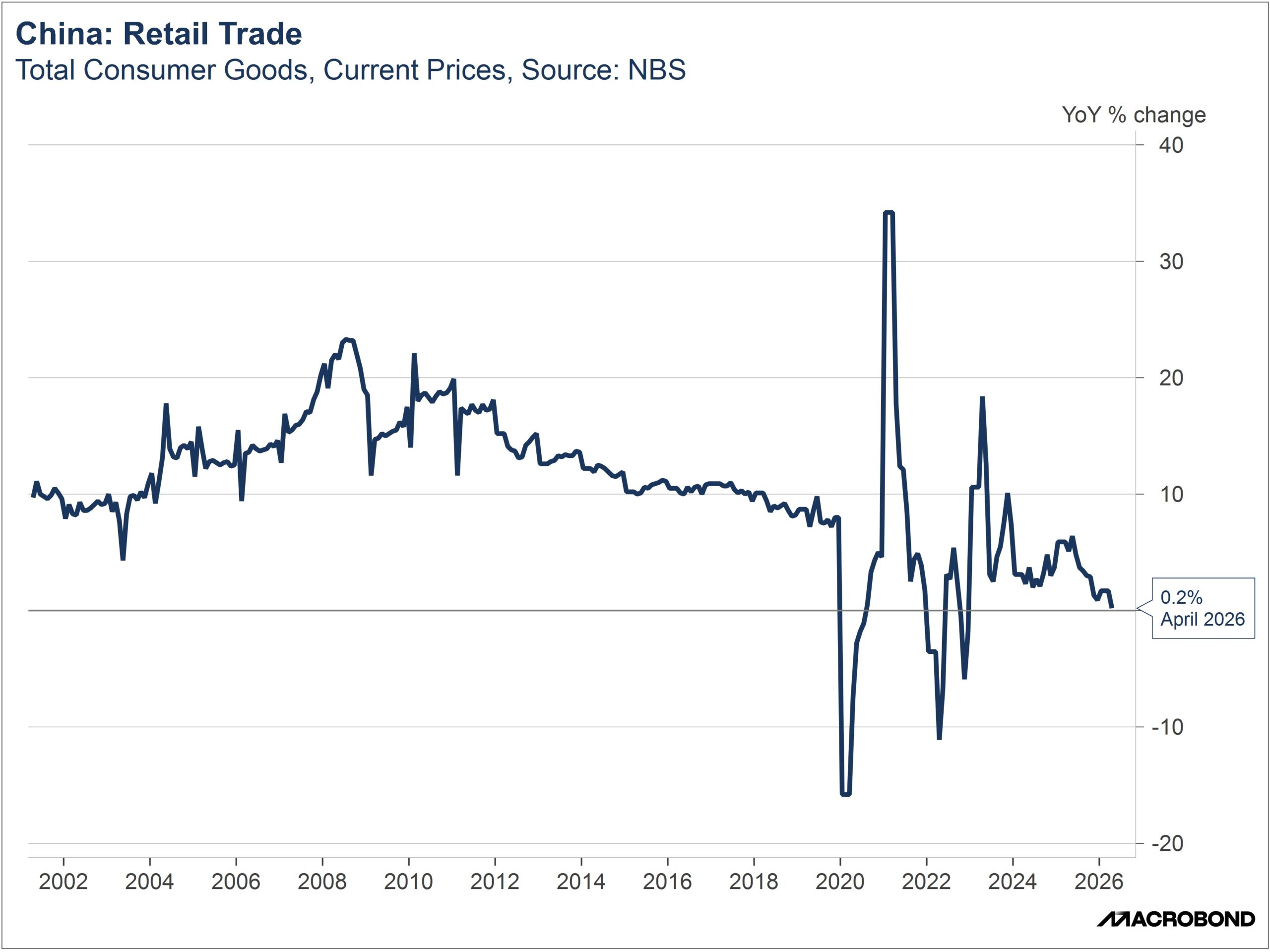
China: Despite strong growth in exports, April retail sales were up just 0.2% from the same month one year earlier, decelerating from their 1.7% rise in the year to March. Industrial production also decelerated, to an annual growth of 4.1% in April versus 5.7% in March. Fixed asset investment in January through April was down 1.6% year-over-year. The figures show how Chinese domestic demand continues to soften, in large part because of the country’s massive excess capacity and debilitating price wars.
Japan: In a major political U-turn, Prime Minister Takaichi today asked her government to develop a supplementary budget for the current fiscal year to fund huge energy subsidies. The goal would be to shield domestic energy users from the full brunt of the price hikes touched off by the US-Israeli war against Iran. However, investors fear the new subsidies would further worsen Japan’s fiscal position. In response, 10-year Japanese government bond yields have risen to 2.746% today, while the yen has depreciated slightly to 159 per dollar.
United States-Israel-Iran: The United Arab Emirates yesterday said a drone strike, apparently launched by Iran, caused a fire at the perimeter of its Barakah nuclear power plant. The strike illustrates that the on-going “ceasefire” hasn’t precluded military attacks by either the US and Iran, rendering it fragile. At the same time, global investment and energy analysts continue to warn that global energy and commodity prices could still suddenly surge, despite the relative complacency in the financial markets.
- Separately, the Financial Times yesterday said European airline and refinery executives have become more confident that the Continent will avoid outright jet fuel shortages this summer. The new confidence reflects the impact of maximized refinery output, increased imports from the US and elsewhere, and governments tapping their strategic reserves.
- The report will be especially welcomed by the European travel industry, which has already seen some flight cancellations and delayed bookings as consumers worried about disruptions to their summer vacation plans.
- We would note, however, that crimped supplies are still buoying jet fuel prices, which will likely have a continued impact on airline ticket prices.
United States-Cuba: In a sign that the US may be setting the stage for a future attack on Cuba, administration officials have begun leaking intelligence saying Havana is acquiring a fleet of attack drones that could target the US base at Guantanamo Bay. That follows a trip to Cuba by CIA Director Ratcliffe last week, during which he reportedly warned Havana to stop funding drug cartels and other groups working against US interests.
- This week, the US Justice Department is also expected to unseal an indictment of Cuba’s de facto leader, Raúl Castro, for allegedly ordering the 1996 downing of two planes flown by a Miami-based aid group.
- The various moves all suggest the US could be developing a series of justifications for an attack on the island and trying to depose the leadership. Of course, another potential reason to do so would be to divert attention from the US’s so-far failed war against Iran.
US Labor Market: The Long Island Rail Road, the nation’s busiest commuter line, remains closed today because of a strike. The shutdown is expected to affect about 300,000 commuters in New York and on Long Island, including many workers in the financial services industry. The key issue in the strike is worker pay, driven in part by employee concerns about continued high price inflation.
US Defense Industry: Some US defense contractors are reportedly lobbying the White House to delay a long-planned prohibition on using Chinese rare earth magnets in military goods starting January 1. Despite the administration pouring billions of dollars of support into the domestic rare earths industry, the lobbying reflects concerns that there still is not enough domestic or allied supply of the magnets, which are essential to a wide range of military and civilian goods. It remains unclear whether the administration will play hardball with the firms or push off the rule.