


Daily Comment (March 31, 2026)
by Patrick Fearon-Hernandez, CFA, and Thomas Wash
[Posted: 9:30 AM ET] | PDF
Our Comment today opens with an update on the war in Iran, which continues to affect not only geopolitics but also economic and political developments around the world. We next review several other international and US developments that could affect the financial markets today, including a statement by Federal Reserve Chair Powell that suggests the central bank will hold interest rates steady for the time being and new data showing airport security lines are shortening now that Transportation Security Administration officers are being paid again.
United States-Israel-Iran: Reports last night said a Kuwaiti oil tanker was hit by an Iranian drone while in the waters of Dubai, sparking a fire. The attack on the tanker came hours after Iran also reportedly hit one of Kuwait’s water desalination plants. The attacks on the energy transporter and the key piece of civilian infrastructure heightened concerns that the conflict is again escalating, pushing global oil prices higher again. At the same time, President Trump has reportedly told aides that he’s willing to end the war without reopening the Strait of Hormuz.
- According to the Wall Street Journal, the president is prioritizing a swift end to the war within the four-to-six week deadline he had stated. That’s likely a political decision based on public aversion to “forever wars” like Afghanistan and Iraq. However, leaving Iran in control of the strait could keep oil and natural gas prices high, especially given that much of the energy infrastructure in the region has been damaged and will take time to repair. The resulting price inflation would also exact a high political cost.
- The administration has suggested that even if the US withdraws without opening the strait, a coalition of interested nations could launch a military campaign to do the job in the future, perhaps with US participation. However, there would be no guarantee that such a coalition would be formed or that it would be strong enough to dislodge the Iranians.
- In a social media post this morning, President Trump said countries suffering from war-induced fuel shortages should buy from the US or simply go and seize it from the strait. The post criticized other countries for not wanting to contribute military forces to open the strait, but foreign leaders are likely to be angry at being criticized for not wanting to clean up after a war they didn’t start. That will likely further erode relations between the US and its allies going forward.
- Leaving the Iranian regime in place with control over the strait would also send a dangerous signal to other potential adversaries of the US. The lesson for those countries would likely be that if they can just hold out against any attack for a month or two, the US will retreat and leave them alone.
- Separately, reports say South Korea, Thailand, and other Asian countries are increasingly restarting coal-fired electricity generation plants as the war disrupts oil and natural gas shipments from the Middle East. Indeed, we think the war will lead to continued concern about the security of Middle Eastern fossil fuel supplies and prompt increased demand for a range of other energy resources, from coal to wind and solar.
- In a more ominous sign of the economic disruption from the war, the last known shipment of jet fuel to the UK from the Middle East is expected to arrive on Thursday. Industry leaders are increasingly warning that shortages of the fuel could soon develop and eventually lead to flight cancellations if the war doesn’t come to a close.
- Because of Europe’s high dependence on natural gas-heated industrial greenhouses to grow its vegetables, high gas prices are also threatening food production beyond the impact of disrupted fertilizer supplies from the Middle East. If agribusiness and grocers can’t pass on the cost of higher gas prices, they may scale back heating, reducing the yield of their facilities.
United States-Cuba-Russia: A Russian tanker today will reportedly deliver 730,000 barrels of oil at the Cuban port of Matanzas, effectively breaking the US’s two-month energy blockade. According to administration officials, the US will now allow fuel deliveries on a case-by-case basis to avert the most dire humanitarian outcomes arising from energy shortages, such as the mass electricity blackouts that the island has been experiencing. The move may also mark US reluctance to spark a new crisis while the war in Iran is still raging.
US Monetary Policy: Speaking to students at Harvard University, Fed Chair Powell yesterday said the central bank would be inclined to hold interest rates steady and look past the energy price shock from the Iran war. However, he also cautioned that the Fed might hike rates if higher energy prices begin to boost consumer expectations for future price inflation. The statements confirm that Fed policymakers are now much less inclined to cut rates than they were before the war. In turn, that realization continues to weigh on bond values, buoying yields.
US Fiscal Policy: While Washington state previously had no income tax at all, Governor Bob Ferguson yesterday signed into law a new 9.9% tax on all income over $1 million. Revenue from the tax is earmarked for childcare programs, free school meals, tax credits for working families, and tax breaks for small businesses. The move follows a tax of 4.0% on incomes over $1 million that was imposed by Massachusetts in 2022 and may signal a greater willingness of state officials to hike taxes on the wealthy.
US Airline Industry: Following President Trump’s executive order that Transportation Security Administration officers be paid despite the continuing Congressional budget impasse, reports say more TSA officers have come to work in recent days and security lines generally shortened on Monday. However, more than one-third of officers still called out sick in Baltimore, Houston, New Orleans, and Atlanta, and the permanent resignation of others will probably keep lines longer than usual for some time to come, discouraging air travel and hurting the airlines.
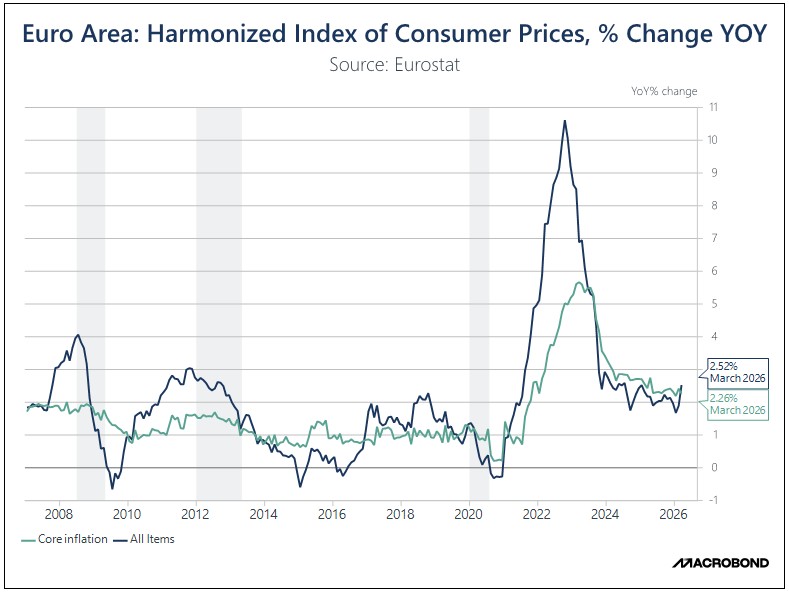
Eurozone: In a preliminary estimate, the March consumer price index was up 2.5% from the same month one year earlier, accelerating from 1.9% in the year to February and marking the bloc’s highest inflation rate since January 2025. The acceleration was driven by a jump in energy prices. Excluding the volatile food and energy components, the March “core” CPI was up 2.3%, decelerating from 2.4% in previous month. The figures show how price inflation is likely to rise because of the war in Iran, potentially leading to interest-rate hikes and slower economic growth.
United Kingdom: The government is considering new legislation that would allow it to buy the inefficient, loss-making British Steel from its current Chinese owner, fully nationalizing the company to protect jobs and ensure some domestic steel production. The move illustrates how countries around the world are committing funds to protect the domestic production of key goods and boost economic resiliency. Over time, more state intervention in the private economy could potentially weigh on economic growth and hurt private firms.