


Daily Comment (June 29, 2026)
by Patrick Fearon-Hernandez, CFA, and Thomas Wash
[Posted: 9:30 AM ET] | PDF
Our Comment begins with key takeaways from Apple’s push to ease restrictions on the purchase of Chinese semiconductors. We then turn to the US-Iran conflict, outlining our assessment of the ceasefire’s durability. Next, we briefly examine Volkswagen’s restructuring efforts, the policy agenda of the leading UK prime minister candidate, and President Putin’s recent and notable admission. As always, we conclude with a review of the latest domestic and international economic data.
Chip Shortage: The scale of the AI buildout is pushing firms to seek regulatory waivers to alleviate mounting supply constraints. Over the weekend, reports indicated that Apple is lobbying the US government for permission to source memory chips from a blacklisted Chinese supplier. The effort comes as Apple has already begun raising prices on key products in response to higher input costs, underscoring growing concerns that AI-related demand is beginning to exert upward pressure on inflation and may eventually weigh on earnings.
- Apple’s push to secure access to Chinese-made chips follows recent price increases across its MacBook and iPad lineup. The company attributed these hikes to constrained access to suitable components, ultimately passing higher input costs on to consumers. In the wake of the rare price increase, Apple’s stock recorded its second-largest single-day loss in company history.
- The iPhone maker’s push to access Chinese-made chips comes as it seeks to navigate US policy constraints amid escalating competition with China over AI dominance. While US rules do not explicitly prohibit commercial purchases from blacklisted Chinese firms, companies that engage with these entities risk losing eligibility to do business with the Department of Defense, creating a meaningful compliance and reputational tradeoff.
- Apple is not alone in passing higher costs on to consumers. Electronics manufacturers including Hewlett-Packard, Dell, Microsoft, and Nintendo have either implemented price increases or signaled upcoming ones to protect margins. Beyond consumer electronics, industries such as automotive, retail, and medical devices have also lobbied the government for relief due to mounting pricing pressure tied to ongoing chip shortages.
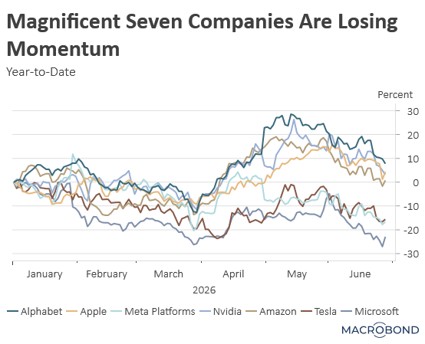
- The AI buildout is reinforcing inflationary pressures from both directions. On the demand side, government incentives, particularly tax credits and subsidies, are draining inventories. On the supply side, trade restrictions and tariffs are boosting competition for inputs. These distortions are beginning to filter into consumer prices; while unlikely to trigger a sharp spike, they point to more persistent inflation and could weigh on margins, raising renewed questions around current valuations.
- Apple’s push to ease restrictions on sourcing Chinese chips underscores how the US drive for supply-chain resiliency is already impacting firm profitability. While firms have successfully raised prices to protect profit margins so far, mounting consumer pushback suggests this strategy cannot be sustained indefinitely. As a result of heightened policy and economic uncertainty, we continue to advocate for a balanced portfolio approach.
Ceasefire Tightrope: Tensions between the United States and Iran remain elevated as both sides contest control over the Strait of Hormuz while simultaneously engaging in longer-term diplomatic negotiations. Over the weekend, hostilities escalated, with both sides exchanging strikes after Iran moved to require shipping vessels to seek permission before transiting the strait. Although the two parties have agreed to continue talks and pause further strikes heading into the week, the episode underscores the fragility of the current ceasefire agreement.
- The dispute appears to center on whether Iran has the authority to impose fees on vessels transiting the Strait of Hormuz. Last week, Iran targeted ships operating along the Oman coast, including vessels involved in a UN-backed effort to assist stranded shipping vessels. In response, the United States launched two-day strikes on Iranian targets, while Iran retaliated by targeting US military bases in Bahrain and Kuwait.
- Although both sides agreed to a temporary halt in military strikes, the resumption of trade flows remains limited. Under the current framework, vessels are permitted to use the UN-backed maritime corridor off the coast of Oman; however, Muscat has reportedly informed European leaders that a transit toll may be imposed. This ongoing friction over potential fees is highly likely to spark another flare-up as both Washington and Tehran attempt to assert leverage in diplomatic talks.
- Washington and Tehran appear intent on continuing talks despite ongoing tensions. Both sides have shown a willingness to use force but also to pursue a longer-term deal, and we expect intermittent tit-for-tat activity as details are negotiated. Our base case is that an agreement is ultimately reached, allowing the conflict-related risk premium in commodity prices to gradually ease, though a breakdown in negotiations would sharply increase market volatility.
VW Overhaul: The German automaker’s proposed restructuring is weighing on sentiment across Europe. The company has proposed a layoff of over 100,000 workers and closure of four plants as profits are squeezed by Chinese competition, US tariffs, and softer European demand. Drawing comparisons to GM’s 2009 overhaul, the move would significantly reshape its operations; even if not yet final, it highlights how European firms must adapt to a changing global environment.
Burnham’s Plan: The prospective UK Prime Minister Andy Burnham is set to lay out his vision for the country on Monday. In his speech, he is expected to advocate devolving more power from London to the regions and to launch a 10‑year mission aimed at lifting living standards through re-industrialization, housing, infrastructure investment, and utility reform. Although he is currently the only declared candidate for the premiership, he is widely seen as the frontrunner in the leadership contest.
Russia Feels Pain: On Sunday, Russian President Vladimir Putin announced that Russia may begin importing energy resources following sustained damage from Ukrainian drone strikes. This rare admission marks one of the first times the Kremlin has publicly acknowledged the extent of the war’s impact on domestic energy infrastructure, potentially signaling a shift in battlefield dynamics away from Moscow’s favor. Despite this development, we continue to view a ceasefire between the parties as a plausible near-term outcome.