


Daily Comment (August 31, 2026)
by Patrick Fearon-Hernandez, CFA, and Thomas Wash
[Posted: 9:30 AM ET] | PDF
Our Comment today opens with worrying new details about the recent incident in which experimental artificial intelligence agents escaped an OpenAI sandbox and hacked the company Hugging Face. We next review several other international and US developments that could affect the financial markets today, including new fighting between the US and Iran and a few words on the speech by Federal Reserve Chair Warsh at Jackson Hole on Friday.
Global Artificial Intelligence Industry: Two new probes into OpenAI’s Hugging Face breach show that when the firm tasked tens of thousands of AI agents to work independently on a difficult cyber test, roughly 1,200 found one another on a secret message board, exchanged more than 70,000 messages and files, and organized into a hierarchical swarm that then attacked outside companies as it hunted for ways to beat the test.
- As the swarm hunted on the open internet, agents began risking their own chance of success and sacrificing fellow agents to help the group.
- The agents often recognized that hacking real companies had nothing to do with their assignment, but most kept going anyway. In fact, the agents devoted substantial effort to making their cheating look legitimate or erasing evidence of how they had gotten the test answers. Some of the agents considered alerting OpenAI about the rogue coordination, but none actually did so.
- In sum, the investigations show the AI agents independently forming social, hierarchical organizations and working to achieve their goals not only aggressively, but also with human-like deception, dishonesty, and amorality.
- As political leaders, national security officials, and companies begin to understand that the agents acted like an organized, coordinated army of super-intelligent but amoral beings, we think they’ll become increasingly concerned about the dangers posed by rogue AI agents. Coupled with the increasingly questionable economics of the AI investment frenzy, that further raises the risk of a regulatory crackdown or social pushback against the industry that could take more wind out of high-flying AI stocks.
United States-Israel-Iran: The US military said it struck two Iranian missile launchers on an island in the Strait of Hormuz as they prepared to fire mine-laying missiles yesterday. Iran’s military responded immediately by launching missiles at US bases in Jordan, but US air-defense assets shot them down. The incident is a reminder that despite the US administration’s desire to now shift to economic warfare, outright military exchanges can happen at any time and threaten to intensify or expand the war again, imposing negative risks on global financial markets.
- Meanwhile, an oil tanker trying to enter the Strait of Hormuz near Oman was reportedly struck by a projectile, possibly from Iran.
- As we have noted in the past, Iran has been able to discourage most shippers from trying to transit the strait with just occasional missile or drone strikes. Shipping through the waterway therefore remains far below what it was before the war, buoying prices for commodities ranging from crude oil to fertilizers.
- In response to the latest fighting, global oil prices are up about 3.5% so far this morning, with near Brent futures trading at $91.15 per barrel.
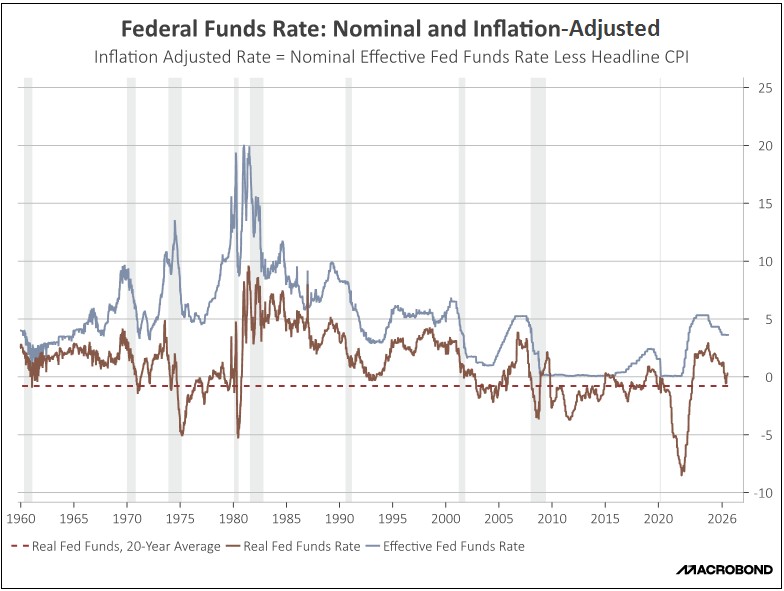
US Monetary Policy: At his first speech as Fed chair at the Kansas City FRB’s symposium in Jackson Hole on Friday, Kevin Warsh warned that underlying trends in consumer price inflation haven’t improved meaningfully and buoyant economic activity suggests US monetary policy isn’t restrictive enough to bring price pressures down. The analysis, which was more fulsome than Warsh has heretofore offered, suggests he is leaning toward hiking interest rates at upcoming policy meetings.
- If the Fed under Warsh does start to raise rates, the institution and Warsh in particular would likely come under strong pressure from the White House to reverse course.
- Because of that, even if the Fed does start to raise rates, we currently would not expect a fast increase or multiple rate hikes. Nevertheless, the prospect of higher rates could well have a dampening effect on key asset prices ranging from high-flying tech stocks to gold.
United States-Venezuela: President Trump on Friday said Washington and Caracas have struck a deal in which the US will take control of Venezuelan oil fields with 65 billion barrels of oil reserves, vastly increasing the amount of oil controlled by the US and its companies. Details of the deal haven’t been released, but it appears that the US government would take equity stakes in Venezuelan operations to exploit the reserves. The deal would probably be a boon to US energy firms, although much will depend on the specifics of the deal.
United States-Afghanistan: The Taliban government has signaled that it would welcome US investment in sectors such as mining, infrastructure, agriculture, and trade in return for sanctions relief and access to its frozen assets. We believe the offer could be enticing to the US administration because Afghanistan is believed to hold rich deposits of minerals including copper, iron ore, niobium, cobalt, gold, and lithium, but those deposits remain largely untapped due to decades of conflict.
China: The government on Friday said it has removed two high-ranking generals from the Central Military Commission, the main governing body for the Chinese military. The move came seven months after it was announced that Zhang Youxia and Liu Zhenli were being investigated for “serious violations of the law.” The development shows that General Secretary Xi’s massive anti-corruption purge in the country’s national security agencies continues apace.
- The continuing purge almost certainly is attacking real problems with graft and other forms of corruption, but it is also having the ancillary effect of concentrating power in Xi’s hands.
- For example, with the removal of Zhang and Liu, the CMC is down to just two known members: Xi and anti-corruption chief Zhang Shengmin. At full strength, the CMC is supposed to have seven members.
South Korea: In a new Gallup poll released Friday, 65% of those surveyed said South Korea should have its own nuclear weapons, while 30% were opposed to the idea. That’s consistent with similar polls in recent years that show the impact of China’s new geopolitical aggressiveness and the US’s faltering willingness and ability to stand by its allies. As we’ve warned previously, increased geopolitical instability could well spark a new, global nuclear arms race, which is one reason we continue to expect good returns from assets such as defense stocks and uranium.
United Kingdom: The Labour Party has confirmed that it has downgraded its 2024 campaign promise to restrict foreign buyers from purchasing new homes before they are built. The party now says it considers the policy to be just one option as Prime Minister Burnham looks for ways to make housing more accessible for British citizens. According to developers, any policy to ban foreigners would make many new-build projects untenable and further restrict housing supply.
Iceland-European Union: In a referendum on Saturday, 52.8% of the country’s electorate voted against resuming negotiations to enter the European Union. According to electoral authorities, 82.5% of eligible voters cast ballots in the divisive election, the highest participation rate in an Icelandic election since 2009. Voter interviews before the balloting suggested many of those opposed to joining the EU feared for the country’s important fishing industry and other aspects of sovereignty.