


Daily Comment (August 28, 2026)
by Patrick Fearon-Hernandez, CFA, and Thomas Wash
[Posted: 9:30 AM ET] | PDF
Our Comment opens with our views on Fed Chair Kevin Warsh as markets await his speech at Jackson Hole. We then turn to Venezuela where the US is pushing for stakes in the oil fields there. Following that, we briefly cover several other topics: Iran’s openness to reengaging with the US in talks, the backlash against EU industrial policy, and Anthropic’s court victory against the Pentagon. As usual, the report concludes with a summary of today’s domestic economic releases.
Forward Guidance in Focus: All eyes will be on Fed Chair Kevin Warsh’s upcoming speech at the Jackson Hole symposium today. His remarks arrive against a backdrop of climbing bond yields, driven in part by mounting uncertainty over the central bank’s policy trajectory. Following two consecutive meetings that exposed deepening divisions within the FOMC regarding the appropriate path forward, markets are increasingly skeptical about the committee’s resolve to steer inflation back to its 2% target.
- Warsh’s address will be closely scrutinized as a key signal for clarifying the Fed’s reaction function and near-term policy bias. While the chair has been consistent in reaffirming the Fed’s commitment to its price-stability mandate, he has remained notably less forthcoming on the specific conditions that would prompt the committee to tighten monetary policy. During the last FOMC press conference, he refrained from stating whether or not the central bank would raise rates even after three dissents.
- Additionally, a growing number of committee members have signaled that a rate hike should at least be on the table, citing the recent stickiness in inflation. On Thursday, Cleveland Fed President Beth Hammack, one of the dissenters, publicly stated that the time for raising rates may be nearing. Earlier this month, Governor Lisa Cook similarly warned that with inflation persisting above target, the risk of entrenched price pressures remains elevated.
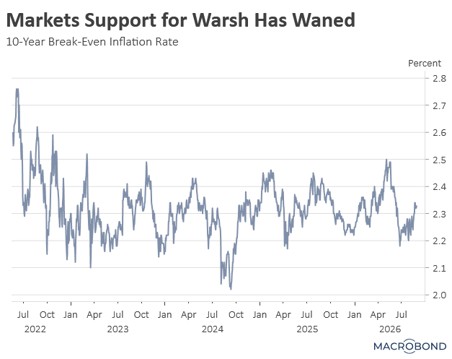
- A lack of clear direction from the Federal Reserve is rattling markets and eroding confidence in the Fed’s ability to contain future inflation. Kevin Warsh’s initial honeymoon period appears to be over; the 10-year breakeven rate has climbed markedly since he took office, signaling deepening inflation anxiety. This shift is particularly striking given Warsh’s historical advocacy for price stability as the central bank’s singular mandate, yet it now suggests that the market is beginning to question his credibility.
- The friction between markets and Fed Chair Warsh has likely not escaped the central bank’s attention. Reports indicate that Warsh has privately acknowledged missteps during his first months in office. While we do not anticipate a sharp reversal of his lean communication strategy, we do expect him to offer the market greater clarity regarding his approach to achieving price stability. His success — or failure — in assuaging market fears will therefore be a key focus for markets today.
Donroe Doctrine: Months after the US formally removed dictator Nicolás Maduro from power in Venezuela, the two countries have moved to rebuild ties. On Thursday, officials announced that the US is in discussions to take a stake in the country’s oil fields. The move is part of a broader US strategy to deepen engagement with South America. This is both to secure critical resources and to reinforce its sphere of influence as it seeks to prevent China from gaining a stronger foothold in the region.
- Under the proposed arrangement, US companies would gain access to develop certain Venezuelan oil fields with proven reserves, while returning a share of the resulting revenue to the Venezuelan government. Although the details remain under negotiation, US officials hope an agreement could strengthen the country’s strategic energy position as it rebuilds resources depleted by the ongoing conflict with Iran.
- The move is part of the US’s broader effort to forge closer ties with South American nations, particularly those with right-leaning governments, as it seeks to counter China’s influence in the region. Over the past several years, Washington has adopted a more interventionist posture across the continent, offering swap lines to Argentina to alleviate its dollar liquidity crunch while coordinating financing efforts in Chile for lithium and rare earth mining projects.
- A growing US presence abroad is likely to bring both advantages and drawbacks. On the positive side, closer ties with foreign governments could diversify US access to critical minerals and energy supplies, strengthening overall resource security and reducing reliance on any single supplier. However, greater dependence on overseas partnerships could also make the United States more vulnerable to political instability and policy shifts in partner countries.
- The White House push reinforces our view of a growing corporatist state approach to expanding US influence abroad. In South America specifically, we expect the Trump administration to continue advancing American interests overseas in hopes of building stronger domestic supply chains. That said, the impact of taking oil stakes in Venezuela will likely not be felt immediately in markets but should begin to bear fruit once projects come online.
Iran Talks: An Iranian diplomat has signaled a willingness to hold talks with the United States in an effort to break the impasse between the two sides. The remarks follow a series of discussions between Iran and Qatar aimed at identifying a path toward resuming negotiations with Washington. It remains unclear whether the United States is prepared to engage. Still, Iran’s outreach suggests that the conditions for renewed talks may be beginning to take shape.
EU’s Industrial Backlash: European trading partners have begun pushing back against the EU’s demands that they comply with its regulations and contribute to its programs in exchange for market access. The backlash comes as smaller countries are increasingly being forced to choose sides among major powers — the EU, China, and the US — as each pursues ambitious reindustrialization agendas.
Anthropic Battle: The AI provider has prevailed in its Pentagon lawsuit, preserving its government contract. A judge ruled Thursday that while the government has wide discretion in choosing partners, it cannot retaliate against a company for exercising First Amendment rights. The decision seems to stem from Anthropic’s public criticism of Pentagon access to its models without safeguards. Though the fight may not be over, the ruling could establish an important precedent for future government contractors.