


Daily Comment (August 27, 2026)
by Patrick Fearon-Hernandez, CFA, and Thomas Wash
[Posted: 9:30 AM ET] | PDF
Our Comment begins with Nvidia’s strong earnings report and the potential implications for the AI trade. We then turn to the Iran‑US conflict, which has entered a new phase. Following that, we briefly cover a few other topics, including Bill Gates’s warning on AI, Lisa Cook’s response to the White House, and recent escalation in the Russia‑Ukraine conflict. As usual, the report concludes with a summary of today’s domestic and economic releases.
AI Gains Life? The AI trade received a boost on Wednesday after Nvidia once again delivered strong earnings and an upbeat outlook. In the second quarter, the chipmaker beat consensus expectations for the 15th consecutive quarter. While the initial report triggered a brief sell-off over concerns about rising capital expenditures, investor anxieties were eased by Nvidia’s projections of robust sales through 2028 and an expanded partnership with Amazon. The strong report may reignite optimism across a sector that has recently faced growing skepticism.
- According to the chipmaker’s earnings report, second quarter revenue rose to $96.22 billion, surpassing the $92.17 billion consensus estimate. The stronger-than-expected result was driven primarily by data-center sales, which accounted for 92% of total revenue. Although the company remains heavily reliant on hyperscalers, it is seeing its customer base broaden to include AI cloud providers, industrial firms, and enterprise customers, a trend that supports its expectation for 70% revenue growth by 2028.
- However, despite the report’s strong positives, it also highlighted several areas of concern. The company identified its rising debt burden as a key risk factor, warning that its obligations could eventually weigh on financial health and cash flow. In addition, higher memory-chip costs have compressed margins, which management expects to bottom out in the fourth quarter. Earlier this month, reports indicated that the company had begun raising chip prices for customers.
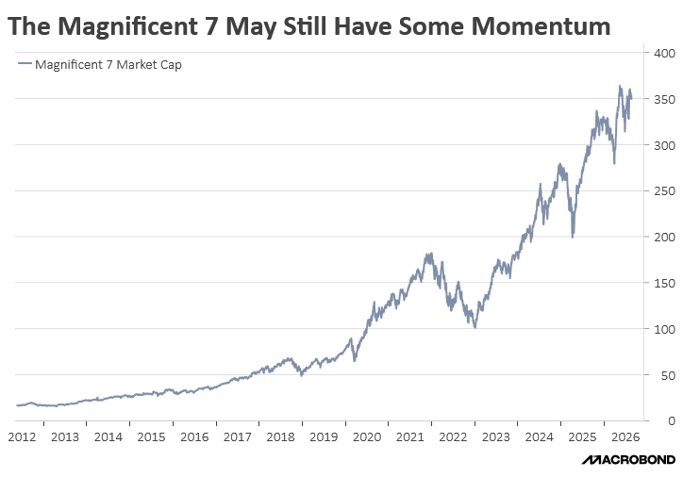
- Better-than-expected earnings at Nvidia are likely to bolster sentiment toward AI-related equities, particularly the “Magnificent” tech giants that have anchored the broader market rally. The results arrive as this group begins to recover from a recent period of weakness. Although these companies continue to demonstrate strong earnings power, investor concerns over the scale of their capital expenditure plans — and uncertainty around the eventual return on that spending — have continued to weigh on valuations.
- That said, the AI trade continues to show sustained momentum and is likely to remain elevated over the short to medium term as infrastructure buildout remains a central market theme and an increasingly important driver of economic activity. At the same time, we see potentially greater long-term value in select companies beyond the small group of names that have attracted the market’s attention. That does not, however, imply that the AI rally is over.
Sanctions over Strikes? The United States is increasingly signaling a shift toward economic leverage over military action in its approach to Iran. On Wednesday, reports indicated that Secretary of State Marco Rubio informed allies that Washington does not plan to initiate strikes in the near term as a punitive measure but will instead intensify sanctions. The announcement comes as the Treasury Department deepens its involvement in the conflict, coinciding with intensified US pressure on Tehran to return to the negotiating table.
- Rubio’s reported admission that the US favors sanctions comes as Treasury Secretary Scott Bessent steps up his involvement in the conflict. Over the last few days, Bessent has announced plans to leverage the dollar-based system and rolled out new sanctions targeting 60 individuals, entities, and vessels that are enabling trade with Iran. The move appears to be having an immediate effect, with the Iranian rial tumbling to an all-time low against the dollar.
- The decision to pursue a more diplomatic approach comes as signs emerge that the fighting has reached a stalemate. Although the United States has achieved military successes by striking several of Iran’s key military assets, it has not prevented Iran from disrupting shipping traffic through the Strait of Hormuz or from retaining the ability to launch attacks against other Middle Eastern countries in the region.
- The shift from military strikes to economic sanctions threatens to draw additional countries into the dispute. In particular, the prospect of expanded US secondary sanctions on countries and companies doing business with Iran — including potentially China, one of Iran’s key economic partners — raises the risk of retaliation from Beijing. Europe also remains on alert after Iran warned Bulgaria against allowing its territory or military facilities to support US operations.
- While the scaling back of military operations may ease near-term market fears of a wider conflict, economic sanctions remain an imperfect tool. Historically, sanctions have delivered mixed results in compelling adversaries to comply with US demands, as illustrated by their failure to deter Russia’s invasion of Ukraine or halt North Korea’s weapons program. As a result, a pivot toward sanctions may create space for further negotiations, but it is unlikely to produce a swift resolution to US-Iran tensions.
Bill Gates Warning: In a recent essay, Gates cautioned that AI poses significant threats to both the labor force and cybersecurity, and he called for a slowdown in its development. His remarks come at a time when several AI models have demonstrated autonomous hacking capabilities and as adoption of the technology continues to rise steadily across the United States. While his views may not have an impact on financial markets right away, they are likely to fuel the ongoing political debate over AI’s evolving role in society.
Fed Governor Under Pressure: On Thursday, Fed Governor Lisa Cook denied any wrongdoing in response to claims made last year by FHFA Director William Pulte, who accused her of misrepresenting her primary residence to obtain more favorable loan terms. Her denial comes three weeks after President Trump suggested he was considering the matter as grounds for her dismissal. Although she has not been formally charged with a crime, the White House has used the allegation to justify firing her. The move is likely to heighten concerns over Fed independence.
Russia-Ukraine: The Russia-Ukraine conflict continues to show signs of escalation. On Wednesday, missiles struck several facilities including a Children’s Hospital. The attack came after Ukraine launched a strike on a facility belonging to a major retailer. The deepening cycle of attacks between the two countries raises the risk of more extreme weaponry being deployed, particularly by Russia. The escalation could potentially push the West to consider increasing their assistance in the conflict.