


Daily Comment (April 7, 2026)
by Patrick Fearon-Hernandez, CFA, and Thomas Wash
[Posted: 9:30 AM ET] | PDF
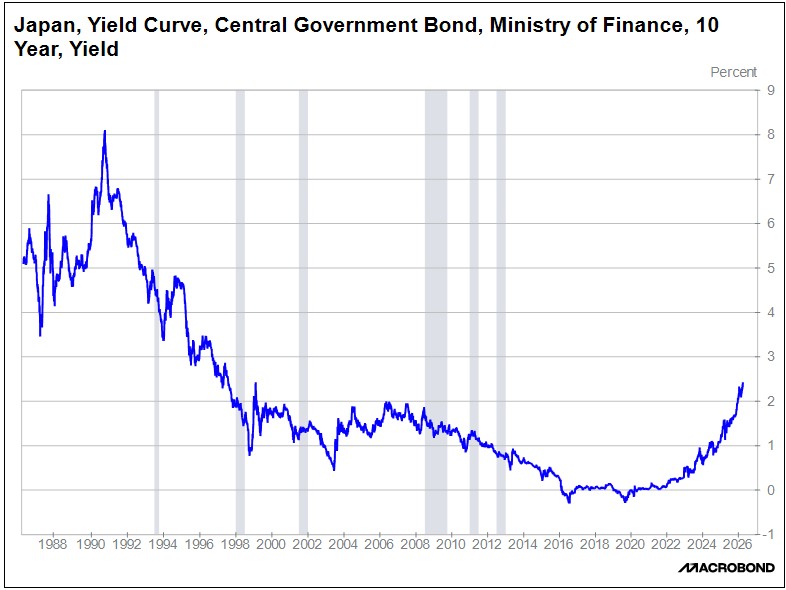
Our Comment today opens with an update on the war in Iran, where it increasingly appears that the Iranian leadership won’t meet President Trump’s 8:00 PM ET deadline to open the Strait of Hormuz. We next review several other international and US developments that could affect the financial markets today, including a slump in Japanese government bond prices that has pushed yields on the benchmark 10-year JGB to a 27-year high and new details on President Trump’s proposal for a massive hike in US defense spending.
United States-Israel-Iran: In a press conference yesterday afternoon, President Trump reiterated his threat to have the US military destroy Iran’s electricity plants and bridges if it doesn’t open the Strait of Hormuz by Tuesday evening, despite the likelihood that such a broad targeting of civilian infrastructure would violate international law. At the same time, a peace deal proposed by Middle Eastern mediators failed to gain the support of both the US and Iran, which raises the chance that the president will follow through with his threat tonight.
- The widescale destruction of Iran’s electricity plants and bridges could well invite the country’s leaders to intensify and broaden their attacks on regional energy facilities and civilian infrastructure, potentially worsening the developing global energy crisis and driving up commodity prices around the world. We believe such Iranian retaliation could be a catalyst for renewed aggressive stock selling by investors.
- As a reminder that disrupted energy supplies and higher fuel prices will likely drive up food prices worldwide, a report in the South China Morning Post today says some farmers in the Philippines have elected to let their crops rot in the fields rather than incur the fuel cost needed to harvest and transport them to market.
- Separately, a report late last week said the US has informed Japan that its planned purchase of about 400 Tomahawk cruise missiles will be disrupted by the war in Iran. According to the report, the US is burning through its arsenal of Tomahawks so quickly that the Pentagon needs to prioritize rebuilding the US inventory once the war ends. As a result, Japan will take longer to develop the long-range strike capability that it has decided is needed to help deter Chinese aggression in the Western Pacific Ocean.
Japan: Little noticed amid all the news from the Iran war, the yield on 10-year Japanese government bonds have been rising and today surged to 2.43%, reaching their highest level since 1999. The jump in yields reflects not only inflation concerns driven by the war, but also the Bank of Japan’s gradual rate hikes and the Takaichi government’s big budget increases. Meanwhile, the yen has weakened to nearly 160 per dollar as investors get more skittish about the impact of rising prices and the general policy stance in Japan.
China-Taiwan: Cheng Li-wun, the leader of Taiwan’s opposition Kuomintang Party, is visiting China today in hopes of meeting General Secretary Xi. Given that the Kuomintang has traditionally been China-friendly, the visit will likely be used by Beijing for propaganda purposes to suggest that many Taiwanese support reunification with the mainland. Cheng’s visit could also embolden the Kuomintang’s current effort to block the Taiwan’s government from implementing its planned surge in defense spending to deter a Chinese takeover.
Vietnam: The National Assembly elected Communist Party chief To Lam today as the country’s new president, making him the first Vietnamese leader to be elected to hold both positions, consolidating control over party and state. The former police officer is expected to continue pursuing his key policy goals, including a crackdown on corruption and reforms to the public and private sectors to further boost Vietnam’s manufacturing sector. In turn, that could further Vietnam’s goal of becoming an alternative production center to China.
US Politics: While it now appears that the key issues in November’s mid-term Congressional elections will be the war in Iran, consumer prices, and artificial intelligence, reports today say a controversial new book on the Trump administration will be out on June 23 and may also reveal secrets that could help swing the election. The book, Regime Change, by Maggie Haberman and Jonathan Swan of the New York Times, could potentially reveal politically charged information just as voters are starting to focus more on the upcoming balloting.
US Fiscal Policy: In a development from late last week, President Trump’s proposed federal budget for the fiscal year starting in October would hike the US defense budget by a massive 44%, or $441 billion, to a total of about $1.5 trillion. Key program hikes would include the president’s “Golden Dome” missile defense system and doubling the number of navy ships to be ordered. Congress is unlikely to pass the budget as proposed, but the draft plan suggests a massive hike in defense spending that could benefit key defense stocks.
US Artificial Intelligence Industry: Yesterday, AI lab Anthropic said it has entered a deal in which it will buy billions of dollars of computer chips and cloud services from Google. Some of the associated chips will come from semiconductor giant Broadcom as well. The announcement shows that big AI deals are still happening, despite growing investor pushback over the huge costs and circular deals that may not make economic sense. In turn, that could potentially be a harbinger of a rebound in AI stock values.
- Separately, Samsung Electronics last night projected that its operating profit would increase eightfold in its first quarter, largely reflecting surging AI-related demand for its memory chips.
- The guidance was much better than analysts had anticipated, boosting Samsung’s share price by about 5% in South Korean trading.
US Healthcare Industry: The government yesterday said its Medicare Advantage payment rates will rise 2.48% in 2027, far better than its January proposal to keep the payments unchanged. The increase is expected to boost payments to health insurers by about $13 billion next year. The news therefore gave a boost to health insurers’ stock prices yesterday, with additional follow-through possible in the coming sessions.