


Daily Comment (April 16, 2026)
by Patrick Fearon-Hernandez, CFA, and Thomas Wash
[Posted: 9:30 AM ET] | PDF
Our Comment opens with a discussion on the renewed surge in AI enthusiasm as a key market theme. We then share our perspective on the EU’s push to strengthen its competitiveness and strategic autonomy from the US. Next, we provide an update on the ongoing conflict in Iran, outline potential implications for the broader Persian Gulf region, and assess why the Fed chair nominee may encounter obstacles in the coming weeks. As always, we include an overview of recent domestic and international economic data.
AI Momentum: As the market’s focus shifts away from the conflict in Iran, AI momentum has begun to resurge. On Wednesday, footwear company Allbirds announced that it was abandoning sneakers to enter the AI infrastructure space under the rebrand NewBird AI. The move arrives as investors grow increasingly fixated on the transformative, and potentially disruptive, impact of AI on traditional business models. While this shift fuels “bubble” concerns, it also underscores the market’s growing consensus that AI will play a foundational role in the future economy.
- The decision by a company once known for making shoes for Silicon Valley to pivot from footwear to data centers underscores the growing centrality of AI. Before the shift, the firm sold its apparel business to a brand management company for $39 million. It now plans to channel those proceeds into AI infrastructure projects, specifically, graphics processing units, to meet the increasing demand. Although the pivot seemed to come out of left field, investors responded enthusiastically, sending the stock up as much as sevenfold.
- Allbirds’ move into AI infrastructure comes amid surging demand to expand AI capacity. The need for cloud computing and chips has driven a wave of investment, with businesses racing to increase supply. That demand has also drawn in Elon Musk, who is raising funds to build Terafab, a venture aimed at supplying chips to tech companies. Meanwhile, Jane Street, a quantitative trading firm, has invested in CoreWeave in order to gain access to its cloud services.
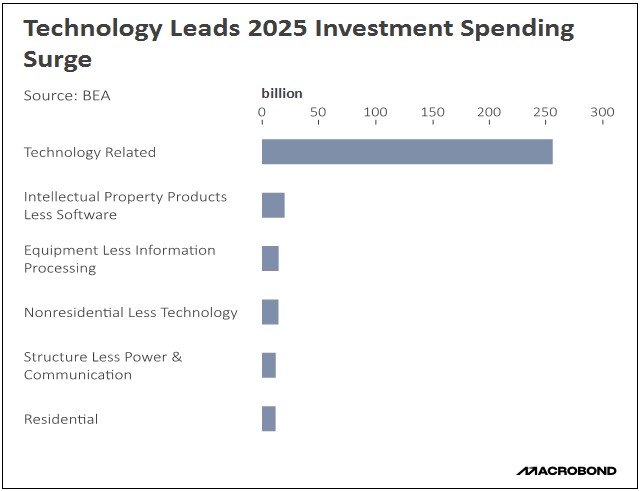
- The growing ubiquity of AI investment has become a crucial pillar supporting the broader economy. In fact, when looking at overall investment spending, the tech sector has dwarfed all other segments of the economy throughout 2025. This high level of spending is likely to continue into the current year, as major tech companies — including Alphabet, Meta, Amazon, and Microsoft — have all revised their capex expectations upward to meet the demand for AI.
- While overall AI momentum has cooled from last year’s levels, the technology remains a key pillar supporting the economy and markets. Allbirds’ surprising shift into AI infrastructure may have raised eyebrows, but the market’s enthusiastic reaction signals that its risk appetite hasn’t faded. With the Iran conflict showing signs of ending, we expect risk-taking to pick up, likely lifting equities in the short term. This momentum could persist, especially given signs of limited supply chain impact.
EU Autonomy: The European Union continues to take steps to reduce its overall dependence on the US. In terms of security, Brussels has attempted to promote a “buy European” approach as it looks to develop its own domestic defense industries and ramp up military spending. Additionally, there are signs that Europe may be moving toward deregulation to improve competitiveness and foster its own national champions. These changes suggest that European markets may become more attractive over the coming years.
- Europe’s need for autonomy has started to create friction within NATO. Following threats from the White House over Greenland and pressure on the EU to spend more on its own security, the bloc has decided to create a fund to raise $1 trillion in additional funding for its rearmament. The push has come at the expense of some of its allies, as Europe looks not only to build up its own military capabilities but also to make its supply chains more resilient, which could come at the expense of its NATO partners.
- Additionally, there have been signs that the European Union has started to loosen its regulations. On Thursday, Brussels proposed relaxing merger rules in an effort to better compete with the US and China. This shift marks a major change for a region that has long prioritized regulation to protect consumers from the outsized power of corporations and suggests that Europe may now be looking to establish its own national champions.
- Europe’s push for greater autonomy is a response to the realization that it can no longer build its economy on the back of US security protection and trade access. As a result, European nations will have to rely on one another to meet those needs. The EU’s decentralized nature, where influence is balanced regardless of country size, complicates this interdependence. While the proposed Capital Markets Union aims to ease tensions, a true fiscal union may be the necessary endgame for stability.
- While the US is still an attractive destination given its deep capital markets, large consumer base, and overall technological advantages, Europe presents a major opportunity, particularly for those looking for value. The EU’s transition may not be as smooth or as quick as investors would like, but we believe the trend is clearly underway. That is why we see significant opportunities for growth in the European market going forward.
Iran Update: Tensions in the Middle East appear to be easing. Lebanon and Israel are weighing a potential ceasefire, while the US and Iran are reportedly discussing a two-week extension to their existing ceasefire agreement as talks continue. Still, a peace deal does not seem imminent. Iran and the US remain far apart on a broader agreement that would address the reopening of the Strait of Hormuz, Iran’s nuclear program, and sanctions relief for Tehran. Despite the lack of a comprehensive deal, markets already appear to be pricing in the belief that conditions will not worsen.
Next Phase for the Middle East: With signs that tensions between Iran and the US are easing, Gulf Coast countries are already looking for ways to repair some of the damage incurred during the conflict. Several nations, including Qatar, Abu Dhabi, and Kuwait, have turned to private markets as a way to raise funds for their rebuilding efforts. Meanwhile, Saudi Arabia is considering canceling its struggling LIV Golf franchise as it seeks money to rebuild its territory. The push is likely a sign that some of the damage caused by the conflict will take a while to fix.
Fed Chair Hold Up: Senator Thom Tillis continues to threaten to hold up the confirmation of Fed chair nominee Kevin Warsh. The outgoing senator has pushed the White House to drop its investigation into the Federal Reserve; otherwise, he will stall the confirmation process. Tillis currently holds the deciding vote and could potentially delay the confirmation, which might force Jerome Powell to stay on beyond the end of his term in May, something the White House is urgently looking to avoid.