


Daily Comment (November 20, 2026)
by Patrick Fearon-Hernandez, CFA, and Thomas Wash
[Posted: 9:30 AM ET] | PDF
Our Comment opens with our take on why Anthropic’s IPO failed to lift broader market sentiment. Next, we examine the UK’s push to strengthen ties with the EU, followed by brief updates on the cyberattacks in Germany, Putin’s openness to an EU proposal to end the Ukraine conflict, and the protests erupting in Italy. As always, we conclude with a review of recent domestic and international economic data.
Anthropic Fails to Lift Sentiment: Even Anthropic’s successful initial public offering (IPO) was not enough to allay broader fears surrounding the AI sector. On Thursday, equities sold off following the Claude maker’s strong Nasdaq debut, weighed down by lingering investor concerns over the overall chip sector’s exposure to China. The pullback underscores how the once-broad AI rally has narrowed as investors have become more selective about their AI exposure, seeking to shield portfolios from segments seen as vulnerable to disruption.
- On its first day of trading, Anthropic shares opened strongly before giving back some of their early gains. The stock climbed from the IPO price of $83 to a peak of around $115 intraday before closing below $100. The initial surge was fueled by a rush of investor demand, with some traders offloading shares in other companies to buy into the debut. Ultimately, the offering topped SpaceX’s IPO fundraising record set earlier this year, underscoring robust investor appetite for AI companies.
- While Anthropic drew heavy demand, investors pulled back from chipmakers. AMD sold off earlier in the day after short-seller Hunterbrook and its sister company published a report highlighting the chipmaker’s China exposure and reliance on circular financing. Specifically, the report alleged that AMD software was used by Washington-blacklisted Chinese entities, and warned that its reliance on data center leases and backstops leaves it vulnerable to an AI capex “bank run” if sentiment sours.
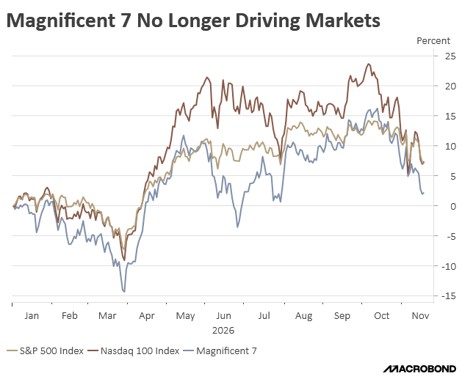
- Although the Magnificent 7 have long served as the primary bellwether for the AI trade, the group has underperformed both the Nasdaq and the S&P 500 this year. Meanwhile, chipmakers, which were among the strongest performers at the start of the year, have given up much of their gains amid growing concerns over the sustainability of the AI buildout. Tech has still done well, but the weak performance in these areas highlights fragility within the AI trade.
- So far, the successful IPOs of SpaceX and Anthropic have reinforced the view that the AI trade remains alive. However, time will tell how much of that momentum can carry over into 2027. We are closely monitoring the ongoing buildout of data centers, as any slowdown could significantly weigh on corporate earnings. While we remain optimistic that the trade will continue, we advocate diversifying into non-AI sectors to limit downside risk if the trend unwinds.
UK Reset: The UK is making progress in rebuilding its ties with the European Union. On Friday, the two sides reached an agreement aimed at unwinding elements of their Brexit arrangements. The push forms part of Prime Minister Andy Burnham’s effort to bring greater stability to the UK after years of policy upheaval following its departure from the bloc. While full reintegration remains far from certain, the approach could offer a blueprint for other nations considering leaving the EU.
- The agreement follows a meeting at the EU summit in Brussels. During discussions over whether the UK might apply to rejoin the bloc or the single market, the two sides agreed to ease some import restrictions on food and drink, as well as to expand mobility for young people. However, EU officials have pressed Burnham to grant equal tuition fee treatment to EU students within six months, a clear sign that the negotiations will require significant concessions.
- Burnham has made building closer ties with the EU a centerpiece of his economic agenda. Since taking office, he has argued that Brexit has failed to deliver the gains promised at the outset of the UK’s exit. He has also called for a public debate on the issue, contending that rejoining the bloc could help revitalize an economy that has struggled to attract foreign direct investment since Brexit.
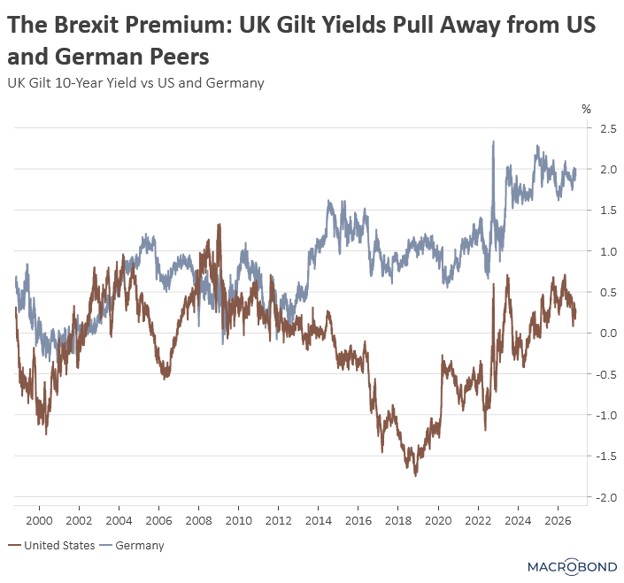
- UK gilt yields have risen relative to those of on German and US government debt. Much of this underperformance stems from a wider government deficit as ministers try to restart growth, as well as from political instability. Public sector net borrowing has increased from 2.3% of GDP in 2016–17 to 4.3% in 2025–26. The country has also had seven prime ministers in the past decade.
- Burnham’s push to establish deeper ties with the EU is likely to reignite a broader debate around Brexit. Any potential agreement will largely hinge on immigration policy, which was the primary driver behind the initial decision to leave the bloc. That said, the prospect of closer alignment, or even a potential reapplication to join the EU, should help boost the attractiveness of equities within the region.
More Cyberattacks: Germany’s information security authority reports that the country was hit by a series of attacks on its critical infrastructure. The incidents appear to stem from AI agents, signaling what could be a large-scale campaign against technical infrastructure in the West. Officials consider the cyber threat severe and expect it to escalate in the coming year, raising urgent questions about the resilience of the digital systems underpinning modern society.
Moscow Invite: Russian President Vladimir Putin has invited the European Union to participate in preliminary discussions as he weighs giving the bloc a formal role in talks to end the war in Ukraine. The move follows a positive one-on-one meeting between Putin and President Trump. As part of a broader resolution to the conflict, Russia is seeking a formal security agreement with the EU. While Putin maintains he will not compromise on his established red lines, he has signaled openness to reviewing a proposal from the bloc.
Major Protests: Italy has become the latest country hit by widespread protests over rising living costs and cuts to public services, including one of the largest strikes in its history. The unrest comes as the country faces mounting stagflation: Annual inflation jumped to 5.5% in October from 4.2% the previous month, while economic growth stalled in the third quarter, remaining flat quarter-over-quarter and up less than 1% year-over-year.