


Daily Comment (November 18, 2026)
by Patrick Fearon-Hernandez, CFA, and Thomas Wash
[Posted: 9:30 AM ET] | PDF
Our Comment opens with a discussion of shifting expectations around monetary policy. We then turn to cybersecurity, examining how recent outages may be linked to security vulnerabilities exposed by AI. Next, we briefly cover Nvidia’s earnings, the first day of the APEC summit, and the latest developments in the Middle East conflict. As always, we conclude with a review of recent domestic and international economic data.
Rate Expectations: Markets are pricing in the reality that the Fed’s fight against inflation is far from over. Over the past few weeks, several committee members have signaled that multiple rate hikes may still be needed to bring price growth under control. With the labor market continuing to strengthen, policymakers have room to focus squarely on their price-stability mandate. The hawkish shift comes amid disagreement over how to respond to the AI boom, at a time of rising economic growth and uncertainty over whether that growth is sustainable.
- St. Louis Fed President Alberto Musalem became the latest central bank official to throw his support behind further policy tightening. Speaking in Argentina, he argued that interest rates are not yet restrictive enough to return inflation to the Fed’s target, making additional increases necessary. He added that the real policy rate (the federal funds target rate minus inflation) needs to reach 2% to 2.5%, a benchmark he estimates will require at least four more rate hikes.
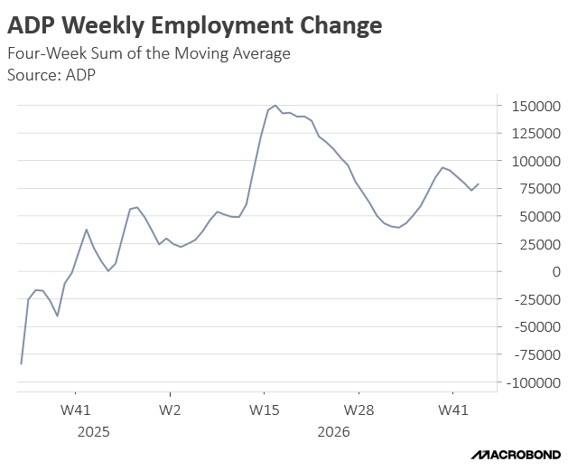
- Musalem — along with other Fed officials, including Cleveland Fed President Beth Hammack and Fed Governor Chris Waller — has pointed to the need for hawkish policy to address these concerns. Their comments come as worries about labor-market weakness have eased. Instead, growing signs indicate that the core of the economy (consumer spending and business investment, excluding inventories) remains resilient and is accelerating, fueling concerns over demand-driven inflation.
- Expectations of tighter monetary policy have already begun rippling through financial markets. In recent weeks, 10-year yields have climbed while gold prices have retreated in anticipation of the shift, as investors shorten duration to limit interest-rate risk. Meanwhile, the US dollar has strengthened, though its gains have been capped by mounting anxiety surrounding the tech rally following Nvidia’s recent pullback.
- While there is strong support within the committee for tightening policy more aggressively next year, fears of a potential unwinding of the AI trade have prompted a more patient approach from other members. Fed Chair Kevin Warsh and Fed Governor Michelle Bowman have both flagged the risk of an economic slowdown. Consequently, while overall sentiment has shifted, the trajectory of the AI sector is expected to play a decisive role in shaping monetary policy in 2027.
Cybersecurity Fears: Over the past few weeks, widespread outages across multiple industries and countries have called the reliability of our technological infrastructure into question. These disruptions come at a time when advances in AI have made cyberattacks easier to execute, prompting warnings that a major breach could even spark a bank run. While financial markets have remained largely unfazed so far, growing security concerns could ultimately slow the pace of AI infrastructure development.
- Earlier this week, two major outages struck the US banking system and the National Security Agency (NSA). Bank of America, JPMorgan Chase, and Wells Fargo all suffered website disruptions that forced them to suspend online services and halt transaction processing. Separately, the NSA’s classified network, which the agency acknowledged has struggled for months, went offline. While services were eventually restored, the incidents have sparked widespread fears of a potential cyberattack.
- The latest wave of technology failures comes just weeks after AI agents uncovered critical vulnerabilities in PHP-based systems and, more recently, in sites linked to Java. In late October, researchers found that PHP, a widely used open-source scripting language, contained two severe flaws that allowed hackers to remotely execute malicious code on affected servers. The risk of potential exploitation led cybersecurity officials to issue a global warning urging vulnerable organizations to patch their systems immediately.
- It remains unclear whether the outages and vulnerabilities are connected, but together they have exposed the fragility of digital infrastructure, a problem that grows sharper as AI introduces new and less predictable risks. Earlier this month, Federal Reserve Governor Michael Barr warned that autonomous AI agents could accelerate bank runs to the point where they unfold in minutes. Public unease is already visible beyond financial markets, with reports of panic buying of nonperishable goods at Costco.
- These outages could revive debate over AI guardrails, particularly if any of them are traced to autonomous agents. The hacking capabilities of Mythos and the Hugging Face breach have already prompted discussion, but neither has led to meaningful change in AI law or regulation. However, as security incidents become more widespread, pressure for greater government oversight could build. As a result, we think these events raise regulatory risk that could weigh on the AI trade.
Nvidia Earnings: The world’s largest chipmaker added to renewed optimism about the AI sector’s prospects with its latest results and outlook. Third-quarter revenue rose 103% from a year earlier to $115.8 billion, ahead of estimates of $109.15 billion. The company also raised its guidance, signaling confidence in its future. It also dismissed speculation of a return of its former CEO Jensen Huang. Overall, the strong results should help ease concerns about an unwind of the AI trade.
APEC Summit: During the initial phase of the APEC summit in Shenzhen, both China and the US struck a diplomatic tone ahead of their scheduled Thursday meeting, with warm greetings between their leaders. Nevertheless, an address delivered by Chinese President Xi Jinping warned that Western nations are employing economic measures to impede emerging global powers. These statements emerge just as bilateral discussions regarding sanctions and tariffs are set to take place between the US and China.
Iran Update: US-Iran tensions escalated Wednesday after a series of tit-for-tat strikes. Following an Iranian attack on a US radar system in Bahrain, the US launched targeted strikes on Qeshm Island on Tuesday, pushing global oil prices higher. Amid growing fears of a prolonged conflict, Vice President JD Vance pushed, vowing to avoid a “two-year commitment” while maintaining that the White House remains focused on containing Iran’s nuclear program.