


Asset Allocation Bi-Weekly – The Inflation Adjustment for Social Security Benefits in 2027 (November 16, 2026)
by Patrick Fearon-Hernandez, CFA | PDF
Even for dedicated, successful investors who have built up a substantial nest egg, Social Security retirement and disability benefits can be a vital part of their financial security. For many people, Social Security benefits are the only significant source of income in advanced age. On average, these benefits account for about 30% of retired people’s income and more than 6% of all personal income in the US. One aspect of Social Security is especially important in today’s period of elevated price inflation: By law, Social Security benefits are adjusted each year to account for changes in the cost of living. In this report, we discuss the Social Security cost-of-living adjustment (COLA) for 2027 and what it implies for the economy.
In mid-October, the Social Security Administration announced that Social Security retirement and disability benefits will increase 3.6% in 2027, bringing the average retirement benefit to an estimated $2,170 per month (see chart below). The increase will bump up the average recipient’s monthly benefit by approximately $75. The benefit increase was right in line with expectations, given that it is computed from a special version of the Consumer Price Index (CPI) that is widely available. The COLA process also affected some other aspects of Social Security, although not necessarily by the same 3.6% rate. For example, the maximum amount of earnings subject to the Social Security tax was raised to $192,300, up 4.2% from $184,500 in 2026.
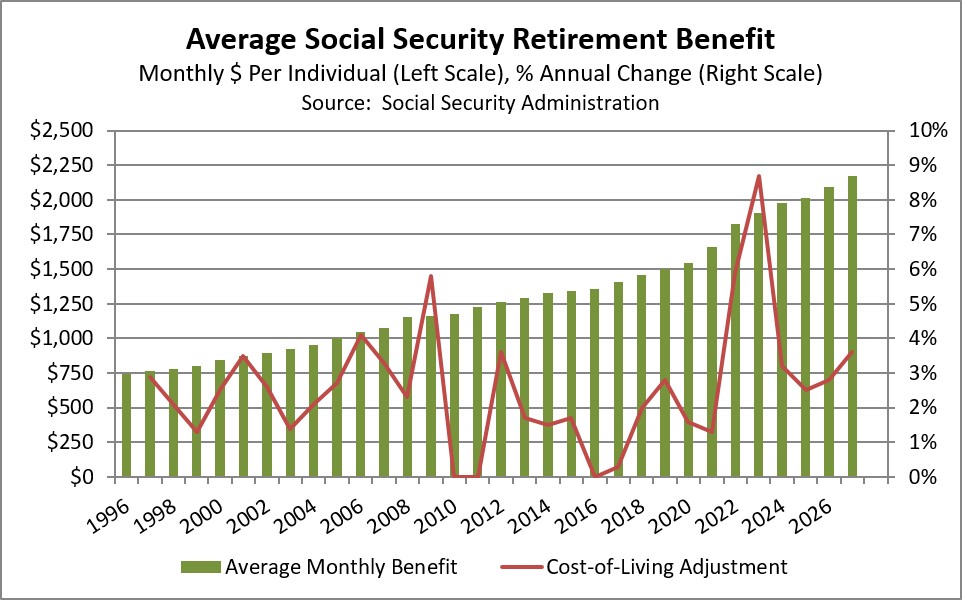
Media commentators often fret that the Social Security COLA could be eroded by rising prices in the following year or that the benefit boost could provide a windfall if inflation decelerates. In truth, the COLA merely aims to compensate beneficiaries for price increases over the past year. It is designed to maintain the purchasing power of a recipient’s benefits based on past price changes, while any changes in the coming year are reflected in the following year’s COLA.
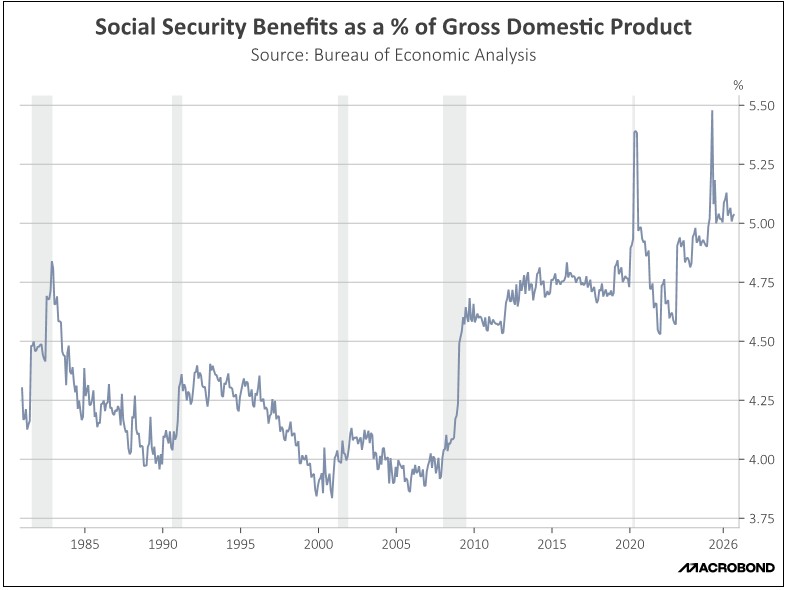
The inflation-adjusted nature of Social Security benefits is also important for the overall economy. Since so many members of the huge baby boomer generation have now retired, and since more people are drawing disability benefits than in the past, Social Security income has become a bigger part of the economy (see next chart). Social Security retirement and disability benefits now account for more than 5% of US gross domestic product (GDP). Having such a large part of the economy subject to automatic cost-of-living adjustments helps ensure that a sizable share of demand is insulated from the ravages of inflation, albeit with some lag. If Social Security income were fixed, a significant portion of the population would see their purchasing power drop more sharply, which might not only reduce demand but could also spark political instability. The added benefits in 2027 will help support demand, although they will also probably keep inflation somewhat higher than it otherwise would be.
Finally, it’s important to remember that an individual’s own Social Security retirement benefit isn’t determined by inflation alone. The formula for computing an individual’s starting benefit is driven in part by that person’s wage and salary history. Higher compensation will boost a retiree’s initial retirement benefit, which will then be adjusted by the COLA over time. As average worker productivity has increased, average wages and salaries have tended to grow faster than inflation. The average Social Security benefit has therefore grown much faster than the CPI. Over the last two decades, the average Social Security retirement benefit has grown at an average annual rate of 3.6%, while the CPI has risen at an average rate of just 2.6%. In sum, Social Security benefits provide a key source of growing purchasing power that helps buoy demand and corporate profits in the economy.