


Daily Comment (November 13, 2026)
by Patrick Fearon-Hernandez, CFA, and Thomas Wash
[Posted: 9:30 AM ET] | PDF
Our Comment opens with our take on the recent leadership shake-up at Nvidia and its potential implications on the crackdown on chip sales to China. We then turn to geopolitics, examining why the US may be downplaying the prospects for a diplomatic solution with Iran. Next, we briefly cover Moscow’s conditions for the EU to join peace talks, a possible leadership change being considered by Senate Democrats, and a Microsoft outage that has disrupted businesses. As always, we conclude with a roundup of key domestic and international economic data.
Nvidia Upheaval: The chipmaker announced Thursday that CFO Colette Kress would replace CEO Jensen Huang on an interim basis while the company searches for a permanent successor. Investors will be looking for a leader who can sustain confidence in the company’s strategy. Meanwhile, government scrutiny of China’s access to US chips adds to the challenges facing the company. Together, these developments are likely to intensify attention on the company’s earnings report and US talks with China next week.
- Several contenders are expected to vie for the top role at the world’s largest chipmaking company. The current Polymarket favorite to succeed Jensen Huang is Ian Buck, who leads the company’s critical data center business, while President Donald Trump has thrown his support behind former Apple CEO Tim Cook. Other leading contenders include current interim CEO Colette Kress, Arm CEO Rene Haas, and AMD CEO Lisa Su. Huang’s daughter, Madison, is also considered a long-shot candidate to take over.
- Amid the leadership controversy surrounding Nvidia, fears of Chinese spies infiltrating chipmakers have spilled over into other companies. Super Micro is currently under investigation by the Department of Justice following allegations that Jensen Huang’s mistress, Alice Huang, was used to smuggle products from the company to China. Prior to the investigation, the company was already facing legal cases involving a plot to send Nvidia-powered servers to China through intermediaries.
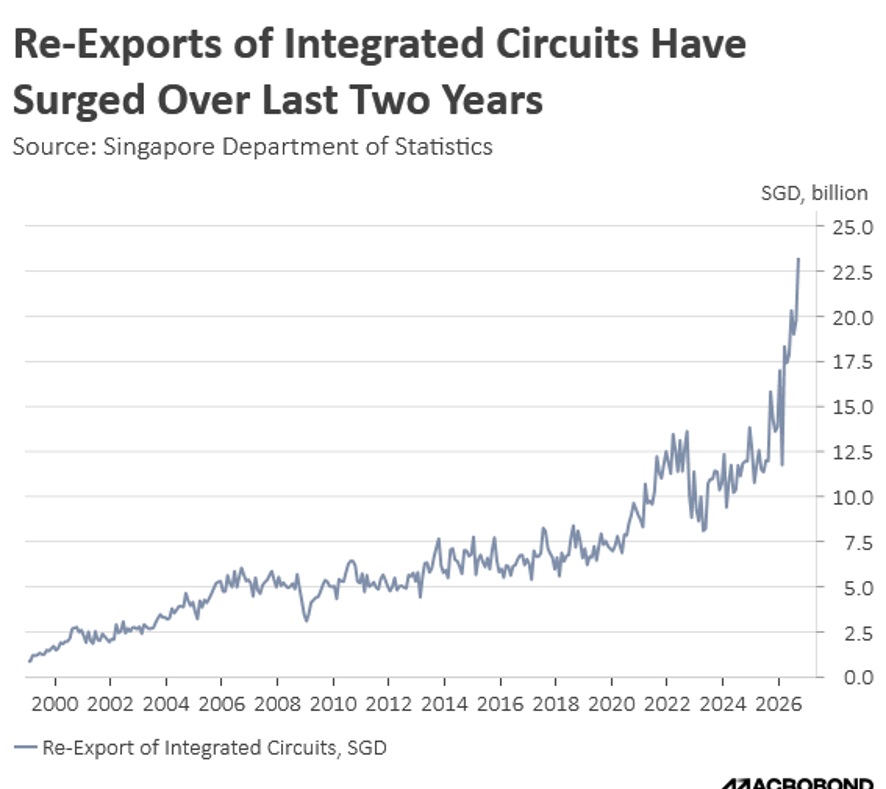
- US efforts to trace semiconductor shipments to China reflect concerns about gaps in export-control enforcement. Reports that China has continued to obtain restricted chips through third countries have intensified scrutiny of potential transshipment hubs, including Singapore. Megaspeed, a singaporean company where Alice Huang held senior leadership roles, has also faced scrutiny. Singapore’s integrated-circuit re-exports provide context for concerns whether restricted chips are reaching China.
- Scrutiny of the chip industry is intensifying ahead of a week that could shape investor sentiment toward AI. Nvidia is scheduled to report earnings on November 17, with investors looking for evidence of sustained demand and guidance supporting further growth. Meanwhile, Presidents Trump and Xi are expected to meet on the sidelines of the November 18–19 APEC summit in Shenzhen, with trade tensions and AI competition and cooperation among the anticipated topics.
Oil Market Fears: Following several days of optimism due to normalization in the energy markets, traders have begun pricing in renewed risks of supply disruptions. On Thursday, President Trump appeared to dismiss prospects for a diplomatic resolution with Iran, pivoting amid indications that Tehran remains unwilling to soften its negotiating stance. Although the president has not explicitly raised the possibility of resuming military strikes, stepping back from diplomatic talks leaves the door open for prolonged regional conflict.
- President Trump instructed Vice President JD Vance to halt backchannel talks with Iran and shift focus toward domestic priorities. This reversal follows recent signals that the White House was weighing broader discussions over Iran’s nuclear program in the coming days, an approach the president had previously expressed openness to pursuing. Explaining the pivot, Trump stated that the US still holds all the leverage and directed Vance to focus instead on addressing alleged corruption in Democratic-led states.
- The shift comes as Iran has signaled an unwillingness to budge on its core demands. On Wednesday, the secretary of Iran’s Supreme National Security Council vowed that not even a single particle of enriched nuclear material would be removed from the country. Additionally, Tehran has pushed back against allowing the UN nuclear watchdog to inspect its sites, citing heightened tensions as both sides continue to exchange targeted attacks.
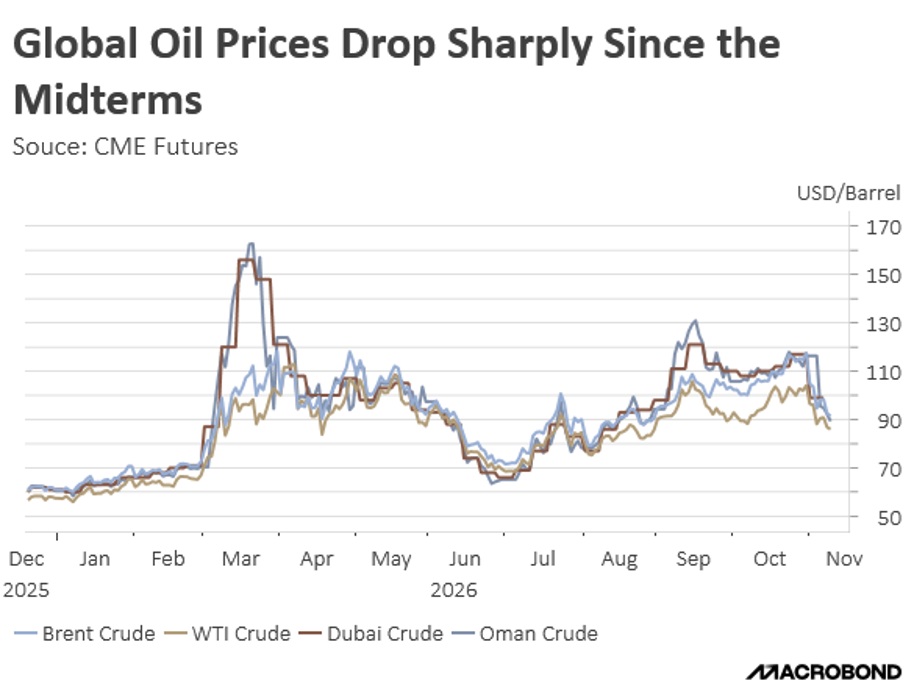
- Renewed policy uncertainty has begun spilling over into the oil market. Following the midterm election results that saw Democrats win control of both chambers of Congress, market participants have started pricing in the possibility of a more constrained US foreign policy in the Middle East. Alongside early signs that oil production levels are returning to normal, this outlook has weighed on crude, driving global benchmarks sharply lower, particularly outside the United States.
- While the president’s decision to withdraw Vice President Vance from the talks may suggest a retreat from diplomacy, it could instead signal a shift in strategy. Unconfirmed reports suggest that the White House is looking to Russian President Vladimir Putin to help broker a deal with Iran. If Putin succeeds, the White House could be more willing to return the favor in negotiations over Ukraine. Although it is too soon to conclude that diplomacy with Iran is off the table, a wider conflict remains a distinct possibility.
Europe at the Table: Moscow has opened the door for the European Union to join peace talks on ending the war in Ukraine, with Russian officials instructing the bloc on Friday to appoint an envoy if it wishes to participate. Discussions are expected to focus on long-term security guarantees between Russia and the EU to address Moscow’s postwar security concerns. While Brussels has previously maintained strict limits on what it will concede, the bloc has signaled a willingness to enter negotiations.
Speaker Fight: Democrats are gearing up for a showdown over who should lead the Senate in the new Congress. Maryland Senator Chris Van Hollen has decided to challenge New York Senator Chuck Schumer for the role. Seen as a leader of the party’s populist left, Van Hollen is positioning himself at the forefront of an effort to rebrand the party following the midterm elections. A leadership shake-up could solidify key progressive priorities as Democrats prepare to challenge the White House over the next two years.
Microsoft Outage: The enterprise software company is struggling to contain a global outage affecting its key products, Outlook and Teams. While the company has made some progress, it warned that users may experience intermittent issues as engineers work to fully resolve the problem. The outage highlights the growing fragility of IT infrastructure as more firms are suffering service interruptions caused by underlying software failures. As the world becomes increasingly tech-dependent, these vulnerabilities could open the door to even greater disruption.