


Daily Comment (November 12, 2026)
by Patrick Fearon-Hernandez, CFA, and Thomas Wash
[Posted: 9:30 AM ET] | PDF
This morning, we open with our perspective on Anthropic’s upcoming IPO later this month. We then turn to geopolitics, explaining why the EU faces difficult discussions to ensure lasting peace on the continent. Next, we briefly cover the potential departure of Nvidia’s CEO, a broader US push to restrict chip sales to China, and Chile finally acknowledging that its economy has entered a downturn. As always, we conclude with a roundup of key domestic and international economic data.
Anthropic Momentum: Anthropic, the creator of Claude, is experiencing immense demand ahead of its initial public offering. Reports indicate that shares are already multiple times oversubscribed, suggesting investors are shrugging off concerns regarding the company’s profitability. Market participants are watching closely to see how the shares perform on their trading debut as the valuation of this leading AI lab will serve as a critical bellwether for its peers.
- The company is scheduled to go public on November 18 to fund its expanding capital expenditure pipeline. Seeking to raise more than $90.4 billion through a combined IPO and private placement, the transaction is projected to surpass SpaceX’s record deal from earlier this year, making it the largest listing on record. Although deal parameters may shift in the coming days, initial guidance targets an overall valuation of $1.4-1.5 trillion.
- Anthropic’s upcoming IPO arrives amid heightened scrutiny surrounding the path to profitability for frontier AI labs. While the Claude developer has delivered massive top-line growth, its draft filings revealed an $80.7 billion net loss in the first half of the year — though over $72 billion of that figure reflects non-cash accounting adjustments on convertible debt. A similar story is unfolding at competitor OpenAI, where heavy operating losses persist despite surging sales.
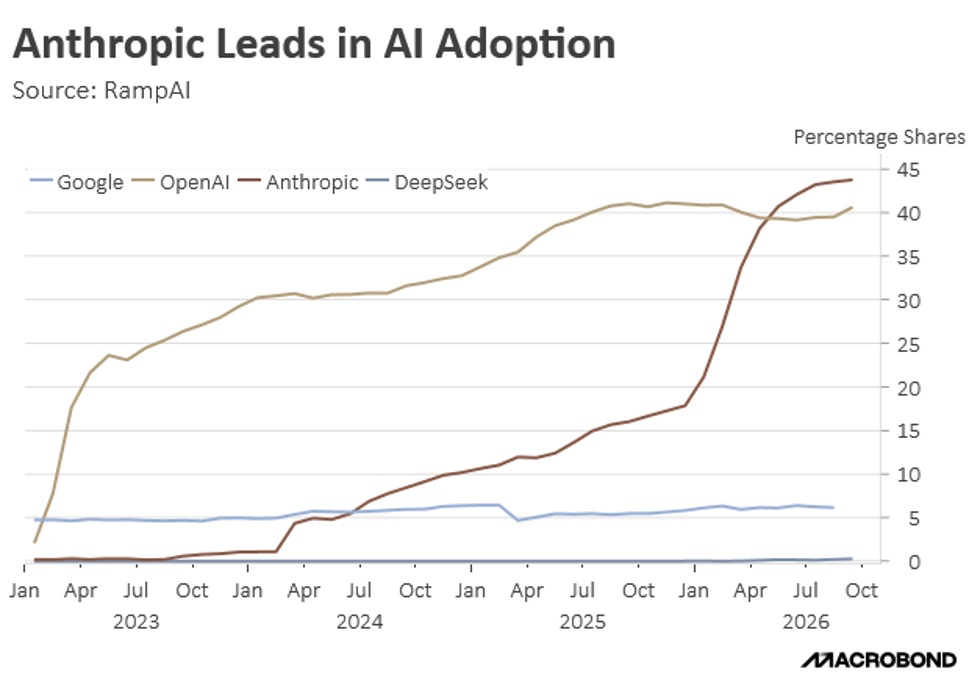
- The key downside risk for AI developers is their cost structure. Large fixed compute contracts with cloud vendors will scale upward as new data centers come online, creating significant operating leverage risk if revenue growth lags behind capacity. To accelerate commercialization and absorb this capacity, labs are moving directly into enterprise software, evidenced by Anthropic’s recent release of an enterprise productivity suite competing with Microsoft Office.
- Anthropic’s public offering will serve as an important indicator for the durability of the AI trade. A strong debut could reignite enthusiasm across the sector and ease concerns that momentum is fading. However, bubble fears are likely to persist given the lingering uncertainties around the long-term profitability of AI labs and data centers. To mitigate downside risk, investors might want to consider diversifying beyond AI-focused equities.
European Defense: EU members and affiliates are holding serious discussions on how to address security vulnerabilities in the face of a resurgent Russian threat. Brussels has grown increasingly alarmed by the warming ties between Washington and Moscow as they push for a peace deal in Ukraine, fearing that Russia is using these talks to reassert its influence in former Soviet states. These concerns have sparked renewed debate over how Europe can independently defend itself against potential large-scale Russian aggression in the future.
- European leaders are set to meet in Dublin for the European Political Community summit to discuss continental security and the war in Ukraine. The gathering coincides with parallel peace negotiations between US representatives and Russia. Washington has made ending the conflict a top priority and recently moved to bring the EU into the fold, but Moscow has resisted European involvement, arguing that Brussels will not offer a fair deal.
- The latest US proposal includes the possibility of establishing a joint security agreement between the EU and Russia. The framework aims to allay Russian concerns over Western encroachment by introducing a pact that limits NATO expansion and scales back the alliance’s military presence in Eastern Europe. However, the EU remains skeptical, claiming that Russia’s ultimate objective is to rebuild a sphere of influence across Eastern Europe that would directly undermine the sovereignty of nations in the region.
- Concerns over recent developments in peace talks have forced the EU to rethink its Russia strategy, though there are no easy solutions. Options under discussion range from recalling troops deployed on overseas crisis-management missions to more extreme proposals for an offensive posture to deter future Russian aggression. However, the bloc’s lack of a unified foreign policy remains a critical vulnerability, making coordinated action difficult.
- The upcoming meeting in Dublin is expected to shape the negotiating stance of European representatives as they work toward ending the conflict in Ukraine. Reports suggest that while European leaders remain skeptical of a proposed security arrangement, they have not ruled out participating in preliminary talks. Although this openness could create an avenue for a broader diplomatic framework to ease regional tensions, it is unlikely to yield an immediate resolution to the war.
Nvidia Shake-up: A new scandal involving beleaguered CEO Jensen Huang has prompted Nvidia’s board to consider removing him from his role. Reports surfaced Wednesday alleging he had an affair with a subordinate, days after revelations of a separate relationship with a suspected Chinese spy. His potential departure comes less than a week before the chipmaker is scheduled to release its quarterly earnings. Because Nvidia remains the heartbeat of the AI trade, growing uncertainty surrounding the company’s leadership could easily spill over into the broader market.
Export Chip Controls: House Speaker Mike Johnson (R-LA) has signaled support for legislation that would further restrict sales of US semiconductors to China. The push reflects broader bipartisan concerns that Beijing continues to acquire American-made chips to power its AI buildout despite existing export controls. Lawmakers have also raised alarms over potential technology leaks following recent reports that Nvidia was infiltrated by a Chinese spy, although no formal legislative response has materialized yet.
Chile Recession: Chile has confirmed its economy has entered a recession, which Finance Minister Jorge Quiroz attributes to sluggish copper output. While Quiroz expects a short-lived contraction, the government is advancing corporate tax cuts and deregulation to stimulate growth and counterbalance the mining slump. Across Latin America, economies are simultaneously confronting stagflation, a combination of slowing growth and rising inflation, driven by global energy price spikes stemming from conflict in the Middle East.