


Daily Comment (September 1, 2026)
by Patrick Fearon-Hernandez, CFA, and Thomas Wash
[Posted: 9:30 AM ET] | PDF
Our Comment opens with today’s continuing global bond sell-off, which is creating headwinds for risk assets as well. We next review several other international and US developments that could affect the financial markets today, including the latest on the war in Iran and signs that artificial intelligence firms could rapidly scale up their advertising businesses despite plenty of other challenges in terms of Chinese competition, citizen pushback against data centers, and other issues.
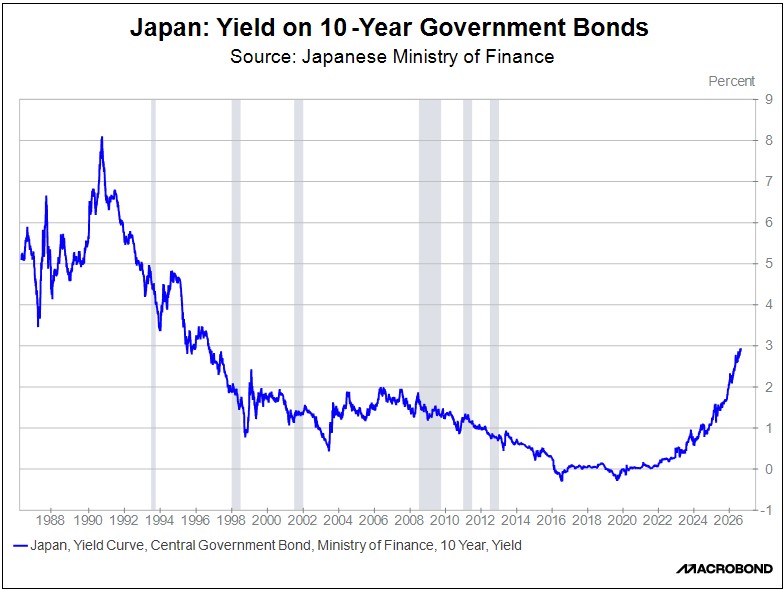
Global Bond Market: Investors continued to cool their bond buying in foreign markets overnight, pushing the yield on Japanese 10-year government bonds to 2.996% for the first time since 1996. Yields also rose to multi-year highs in Germany, France, and other markets. At this writing, the yield on 10-year US Treasury obligations has risen to 4.789%. The bond sell-off reflects concerns about economic overheating, high price inflation, rising debt levels, and other factors. The renewed upward move in yields is also weighing on US stock prices so far today.
United States-Israel-Iran: President Trump yesterday warned that his administration will respond to Iran’s retaliation for a US strike against two Iranian missile launchers. According to Trump, “We’re going to hit them hard.” The statement suggests a new spiral of US-Iran attacks could be about to begin, which would again raise the risk of further shipping restrictions in the Strait of Hormuz, higher energy and commodity prices, and increased volatility in global financial markets.
- Indeed, two oil tankers trying to exit the Persian Gulf were hit by “unknown projectiles” last night. If the attack came from Iran, as seems likely, it would underscore how the country retains enough firepower to keep disrupting shipping in the waterway.
- As a result, global oil prices are up approximately 2.0% so far today, with near Brent futures trading at $92.42 per barrel as of this writing.
United States-Venezuela: North American Blue Energy Partners, the private company through which the Trump administration will hold its recently announced equity stake in Venezuelan oil fields, reportedly plans to rapidly increase the number of drilling rigs it deploys in the country to more than 50 in the coming years. The aim is to quickly boost Venezuela’s oil output after its long slide under the governments of Hugo Chavez and Nicolas Maduro. The boost could have a meaningful impact on global energy supplies and help hold down prices over time.
Eurozone: In an initial estimate, the August consumer price index was up 3.3% from the same month one year earlier, matching estimates and accelerating from a gain of 2.9% in the year to July. Excluding volatile categories such as food and energy, the August “core” CPI was up 2.4% on the year, decelerating a bit from the annual rise of 2.5% in July but still coming in well above the European Central Bank’s target of 2.0%. The figures suggest the ECB will indeed hike its benchmark short-term interest rate again this month, as is widely expected.
South Korea: President Lee Jae Myung’s government today proposed hiking its budget by 12.8% in 2027 to the equivalent of $598 billion. The figure includes about $118.2 billion for an endowment-style “Future Response Fund” financed largely by soaring tax receipts from chipmakers such as Samsung Electronics and SK Hynix. The fund would support firms working on artificial intelligence and other cutting-edge industries in order to ensure South Korea remains prosperous into the future.
India: After stripping out price changes, the country’s second-quarter gross domestic product was up a strong 7.8% from the same period one year earlier, beating expectations but still decelerating a bit from the 8.6% increase in the year ended in the first quarter. The main sources of growth in the year to the first quarter were consumer spending, government spending, fixed investment, and exports. The data should be bullish for Indian stocks.
US Labor Market: Transportation Secretary Sean Duffy has announced that his agency forced the emergency shutdown of nearly 300 truck driving schools that he said were failing to train commercial drivers properly. He also said the Transportation Department has stepped up its apprehensions of commercial drivers who have a valid license but may be in the US illegally. The announcement highlights how the administration’s immigration crackdown continues to affect the US labor supply, crimping job growth but holding down the unemployment rate.
US Artificial Intelligence Industry: OpenAI yesterday said its advertising business has reached a $1 billion annualized revenue run rate less than 200 days after launch. According to the firm, the self-service ad platform is already being used by tens of thousands of businesses, including many small and medium-sized companies. Separately, analysis by WPP Media says generative AI search ad revenue is now the fastest-growing ad format in history. While other issues have made investors more wary of AI, the new data could help prolong positive sentiment about it.