


Asset Allocation Bi-Weekly – The Impact of New Equity Supply (August 31, 2026)
by Bill O’Grady | PDF
In November 1982, the Securities and Exchange Commission (SEC) changed its position on stock buybacks. Prior to this change, the SEC held that buybacks were potentially market manipulation. They weren’t directly banned, but companies buying back their stock ran the risk of being sanctioned for manipulation. In 1982, the SEC decided it needed to clarify its position on buybacks with the introduction of Rule 10b-18, which codified safe harbor requirements for buybacks. Specifically, firms buying back their stock are required to meet the following conditions:
- Use a single broker or dealer per day to bid for or purchase their stock;
- Abide by certain timing restrictions intended to prevent companies from establishing either the opening or closing price of their stock;
- Not offer a price exceeding the highest independent bid or the last independent transaction price on the relevant exchange, whichever is higher; and
- Limit daily repurchases to 25% of the average daily trading volume of their securities during the previous month.
Companies can reward shareholders primarily through dividends or buybacks. The former are simply a cash payment for holding the shares. Unfortunately, they are less tax efficient. Not only do dividend payments stem from after-tax corporate earnings, but the shareholder pays income tax on them as well. Thus, they are “double taxed.” In contrast, buybacks aren’t taxed at all, and by reducing the shares outstanding, all else held equal, one would expect them to push the share price higher.
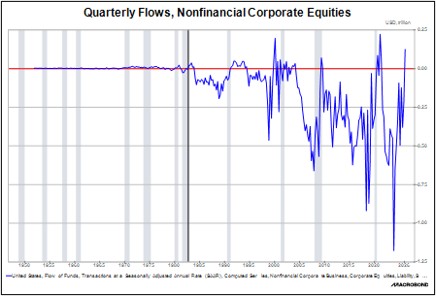
The chart on the next page, from the Federal Reserve’s Financial Accounts of the United States, measures quarterly share flow for the non-financial corporate sector over many decades. In any given quarter, a positive number indicates more shares were issued than extinguished, and vice versa. The chart shows that before the SEC rule change in 1982, only 19% of quarters registered negative flows. After the rule change, this number jumped to 81%.
Due in part to their favorable tax treatment, buybacks became the preferred way to reward shareholders, but another factor had to do with the allocation of power between management and owners. After the Great Depression, there was a bias in corporate governance in favor of labor. Management theorists lamented that management didn’t represent the interests of owners. The change in buyback regulation coincided with the concept of shareholder primacy, which argued that publicly traded firms should focus on shareholder returns over other interests. Senior managers and, over time, other workers were partly paid in shares, aligning management with owners. Persistent buybacks became an element of shareholder primacy.
In the next chart, we’ve aggregated the flows data (blue) to show the accumulated buybacks over time. We’ve also overlayed that data with the S&P 500 price index (pink).
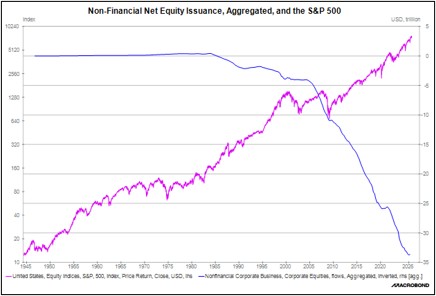
The trends in both series are rather obvious, but after the Great Financial Crisis, buybacks played an increasing role in supporting stock prices. It’s worth noting that in periods where cumulative buybacks slowed, the market stalled. That’s important now because the funding needs for artificial intelligence investment are leading to increased equity issuance, as the first chart shows. This new stock issuance will almost certainly increase in the coming quarters. For instance, the recent initial public offering (IPO) for SpaceX isn’t recorded in this data yet. The expected IPOs of Anthropic and OpenAI will likely lift issuance even further.
This analysis doesn’t necessarily mean a bear market is looming. However, it does indicate that equity markets could face headwinds in the coming quarters as more firms issue stock to fund their AI investment needs. We therefore think that diversifying into neglected areas of the equity markets, such as value and international, would offer some degree of protection from projected overall market weakness.