


Daily Comment (August 26, 2026)
by Patrick Fearon-Hernandez, CFA, and Thomas Wash
[Posted: 9:30 AM ET] | PDF
Our Comment begins with the escalating trade tensions between the US and Canada and why China may be behind the rift. We next examine the fiscal front, analyzing Richmond Fed President Thomas Barkin’s concerns about the growing deficit and the potential risks to the bond market. The next sections provide updates on three distinct fronts: diplomatic efforts between Iran and Oman to ease transit in the strait, primary wins bolstering Trump’s pre-midterm standing, and Huawei’s offensive to distribute its chips worldwide.
Canada-US Trade: Trade tensions between the United States and Canada flared on Tuesday as both countries sought leverage in ongoing negotiations. Ottawa imposed retaliatory duties on $20 billion of US imports, directly mirroring Washington’s initial measures. The back-and-forth comes as each side accuses the other of negotiating in bad faith. The rift also occurs as the United States prepares for high-stakes trade talks with China next month. Washington’s pressure campaign against Canada may offer insight into what it hopes to achieve in talks with Beijing.
- The latest round of duties peaking at 50% on certain goods is scheduled to take effect on September 8. Canada has tailored its retaliation to target specific sectors of bilateral trade, including dairy, steel, and agricultural equipment. However, the delayed implementation suggests Ottawa is deliberately leaving the door open for continued dialogue before the economic blow lands. Washington has already countered with a threat of its own by vowing to impose additional tariffs on Canadian imports starting on New Year’s Day.
- Rising trade tensions between the US and Canada may have less to do with personal friction than with the broader strategic shadow of China. Washington and Ottawa had previously been in discussions over forging a unified trade and investment front designed to make North American supply chains “China-proof.” However, given Canada’s recent overtures toward closer economic ties with Beijing, it appears Ottawa was unwilling to abandon that potential leverage without securing significant concessions in return.
- Despite the escalating rhetoric, markets appear to be shrugging off the ongoing row and its potential fallout. The S&P 500 closed up 0.3% on the day, while Canada’s benchmark S&P/TSX finished nearly 0.7% higher. This muted reaction suggests that, for now, the tariff measures remain insufficient to trigger major market disruptions. Key sectors, particularly US tech and Canadian energy, seem largely insulated from the tit-for-tat, with investors betting on a contained outcome rather than a full-blown trade war.
- Still, the real focus centers on next month’s US-China trade talks. If Washington uses its leverage with Canada to extract a stronger position against Beijing, markets and the broader economy stand to benefit. However, a more aggressive stance with Beijing that triggers another cycle of retaliatory tariffs will likely drive up market volatility. For now, the former scenario appears more likely than the latter.
Growing Deficit Concerns: The US Treasury’s recent actions have sharpened investor focus on the swelling federal deficit. On Tuesday, Richmond Fed President Thomas Barkin warned that America’s mounting debt burden could eventually provoke investor pushback if borrowing continues to rise unchecked. His remarks come as the Treasury has taken more aggressive steps to smooth the impact of heavier issuance on interest rates.
- Although Barkin later conceded that the exact point at which investor resistance might materialize remains inherently difficult to project, he characterized the outcome as virtually assured. He attributed this forecasting challenge to two structural advantages that continue to insulate the US: the country’s robust legal framework and its preeminent position as the issuer of the global reserve currency. These factors, in his view, have thus far deferred, but not eliminated, the risk.
- Despite his deficit concerns, Barkin has stated that he does not believe interest rates have yet had a meaningful impact on the broader economy. His relative optimism may partly reflect the Treasury’s more hands-on approach to easing pressure on long-term bonds. And while the recent bond buyback program has drawn considerable attention, it is worth noting that the Treasury’s sustained shift toward shorter-dated issuance over the past three to four years has likely played an even greater role in anchoring rates.
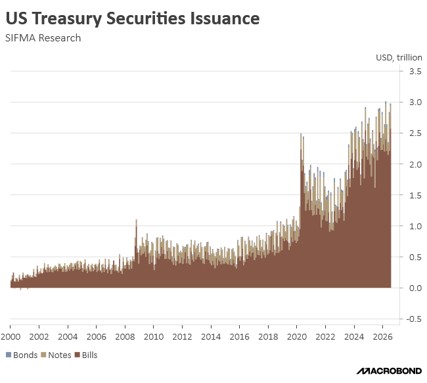
- According to the latest data from SIFMA Research, US Treasury bill issuance has surged since 2023 to levels not seen since the height of the pandemic. This reallocation — later termed “Activist Treasury Issuance” in a paper authored by former Fed Governor Stephen Miran and Nouriel Roubini — helped ease pressure on long-term bond yields. As a result, the 10-year Treasury yield fell from a peak of 4.99% in October 2023 to as low as 3.62% roughly a year later.
- While monetary policy, inflation expectations, economic growth, and investor preferences will continue to be key drivers of the yield curve, we believe Treasury debt-management decisions will become an increasingly relevant factor as federal borrowing needs rise. Greater bond issuance could exert upward pressure on yields and term premia, especially if investor demand fails to keep pace. This dynamic is particularly pronounced for longer-dated securities, where demand has notably softened.
A Possible Strait Deal? Iran and Oman appear close to an agreement that could potentially reopen the Strait of Hormuz. The two sides have announced terms to establish a maritime corridor for commercial shipping, but the arrangement does not necessarily guarantee that the strait will reopen. Iran has said it will do so only if the United States meets its conditions, including lifting the naval blockade and reinstating a waiver permitting Iranian oil sales. Still, the agreement will likely create an opening for further negotiations.
Trump Bump: Two Republican candidates endorsed by President Trump won their primary runoffs on Tuesday. The higher-profile contest was South Carolina’s Senate race, where Darline Graham defeated Ralph Norman. Meanwhile, former state Senator Mike Mazzei won Oklahoma’s Republican gubernatorial primary runoff. Both contests are likely to be decisive in determining who ultimately holds the seats, underscoring Trump’s continued influence within the Republican Party heading into the midterm elections.
Chinese Competition: Huawei is bidding to build a data center in Egypt using its own chips, a move that could expand the company’s international footprint as it seeks to compete with Nvidia in AI infrastructure. The effort also appears to fit within China’s broader strategy to challenge US chip diplomacy by strengthening technology and investment ties with emerging-market economies.