


Asset Allocation Bi-Weekly – China’s Threat to the AI Investment Boom (August 17, 2026)
by Patrick Fearon-Hernandez | PDF
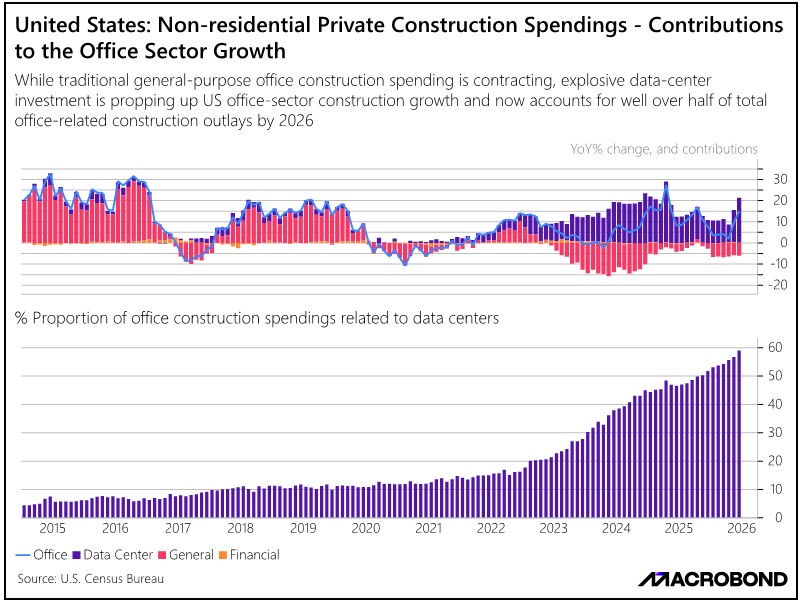
The artificial intelligence frenzy has arguably become the most important driver of US economic growth and financial market returns. Large technology firms ranging from established giants like Meta to upstart powerhouses such as OpenAI are spending billions of dollars to develop the most powerful large language models. To accommodate the models, many firms are spending huge sums to build enormous, power-hungry data centers. As shown in the chart below, that spending alone has been enough to offset the pullback in constructing traditional office structures.
Indeed, the investment in AI and AI infrastructure is now driving up demand for everything from concrete and steel to cooling equipment, computer servers, cables, microprocessors, and memory chips. Analysts estimate the AI investment frenzy accounts for perhaps one-third of current US economic growth. The result has been rising stock prices for firms ranging from semiconductor manufacturers to heavy equipment makers, despite increasing concerns about stretched valuations, rising debt, and daisy-chain investment deals. In our view, these trends have already made the sector look toppy and risky. Now, we’re seeing increased evidence that the competitive threat from Chinese AI firms could potentially be the catalyst that throws the US AI boom into reverse.
One problem for the leading AI firms in the US is that China’s firms have now essentially caught up with them technologically. At the end of July, for example, Chinese AI lab DeepSeek released a new coding model, V4 Flash, that tests show can perform almost at the level of Anthropic’s Opus 4.8, widely seen as one of the industry’s most capable systems. The strong performance by V4 Flash came just days after the release of another surprisingly capable Chinese model, Moonshot AI’s Kimi K3. According to tests, the performance of Kimi K3 rivals not only Opus 4.8, but also OpenAI’s GPT-5.6 Sol. From a “total user experience” perspective, many firms around the world may even consider the flexible, open-source Chinese models to be superior to US offerings.
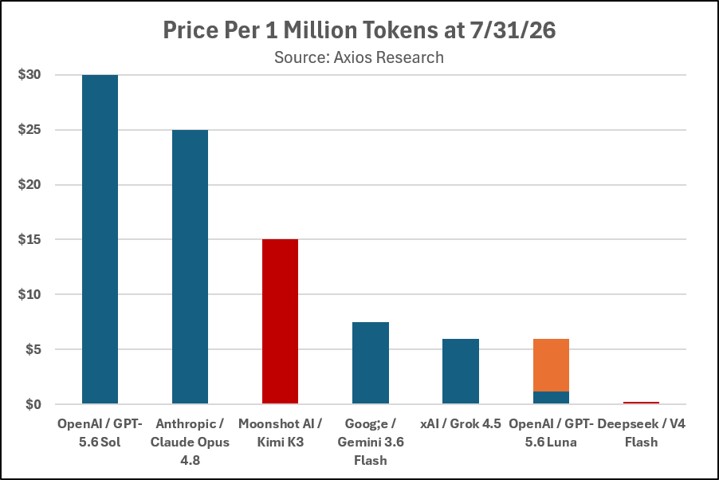
At the same time, we think there’s an even more important development that could undermine the prospects of top US firms: extremely low pricing by the Chinese firms. For instance, DeepSeek has priced its new V4 Flash model at about $0.28 for the same amount of output that costs $25.00 with Anthropic’s Opus 4.8. The aggressive pricing by DeepSeek came one day after OpenAI slashed the price of its GPT-5.6 Luna model by 80% from its launch price three weeks earlier. At the new price, GPT-5.6 Luna costs $1.20 for the same amount of output that costs $0.28 with V4 Flash and $25.00 with Opus 4.8 (see chart below).
In our view, China’s predatory pricing moves shouldn’t be a surprise. Consistent with the Chinese Communist Party’s longstanding goal for the country to become a manufacturing powerhouse and dominate the world’s key industries, China has driven scores of foreign industries out of business over the decades. It has typically done this by subsidizing Chinese producers and/or forcing them to accept lower profits so they can undercut their foreign competitors. After applying this strategy to industries such as steel, rare-earth processing, automobiles, and electronics, Beijing would almost certainly be willing to do the same with a key industry of the future such as AI.
Some observers are holding out hope that even if China eventually dominates lower-cost AI services, US firms can still lead in the more sophisticated, higher-value AI services and therefore make good on their current investments. For instance, it appears that Anthropic is trying to position its cutting-edge models as a premium product worthy of premium pricing. However, DeepSeek’s aggressive new pricing move shows that Anthropic and other US firms are facing such an extreme competitive threat from Chinese AI firms that they may not be able to defend their top-tier pricing. Even as the US firms invest heavily in model development and infrastructure, raising their costs, the Chinese firms are proving they can create models that are essentially just as good but priced as much as 99% lower. As investors come to appreciate the Chinese threat, the AI frenzy in the US could become increasingly shaky.