


Daily Comment (May 19, 2026)
by Patrick Fearon-Hernandez, CFA, and Thomas Wash
[Posted: 9:30 AM ET] | PDF
Our Comment today opens with a short update on the war in Iran. We next review several other international and US developments that could affect the financial markets today, including a report of stronger-than-expected economic growth in Japan in the first quarter and several items on the US artificial intelligence and energy industries.
United States-Israel-Iran: President Trump yesterday said he’d delayed a plan for new military attacks on Iran today at the request of leaders in the Middle East. According to Trump, the delay was justified because Iranian leaders have finally entered into “serious negotiations.” However, the US has now gone through several cycles of ultimatums and threats followed by backdowns, so the latest retreat could increase investor concern that the US is having no success convincing the Iranians to reopen the Strait of Hormuz to shipping.
- If so, the continued disruptions to global energy and commodity supplies are increasingly likely to spark a fresh spike in price inflation.
- In turn, that is likely to keep undermining bond values, driving up yields, while also increasing the risk of a pullback in stock prices.
Japan-South Korea: In a summit meeting today, Japanese Prime Minister Sanae Takaichi and South Korean President Lee Jae Myung agreed to a broad program of cooperation geared at shoring up their energy supplies. The program includes joint reserves of crude oil, shared supplies of critical refined products, such as jet fuel, and swap arrangements for liquified natural gas. Besides pointing to improved Japanese-South Korean relations as the two nations face bigger external threats, the program also highlights their vulnerability to energy supply shocks.
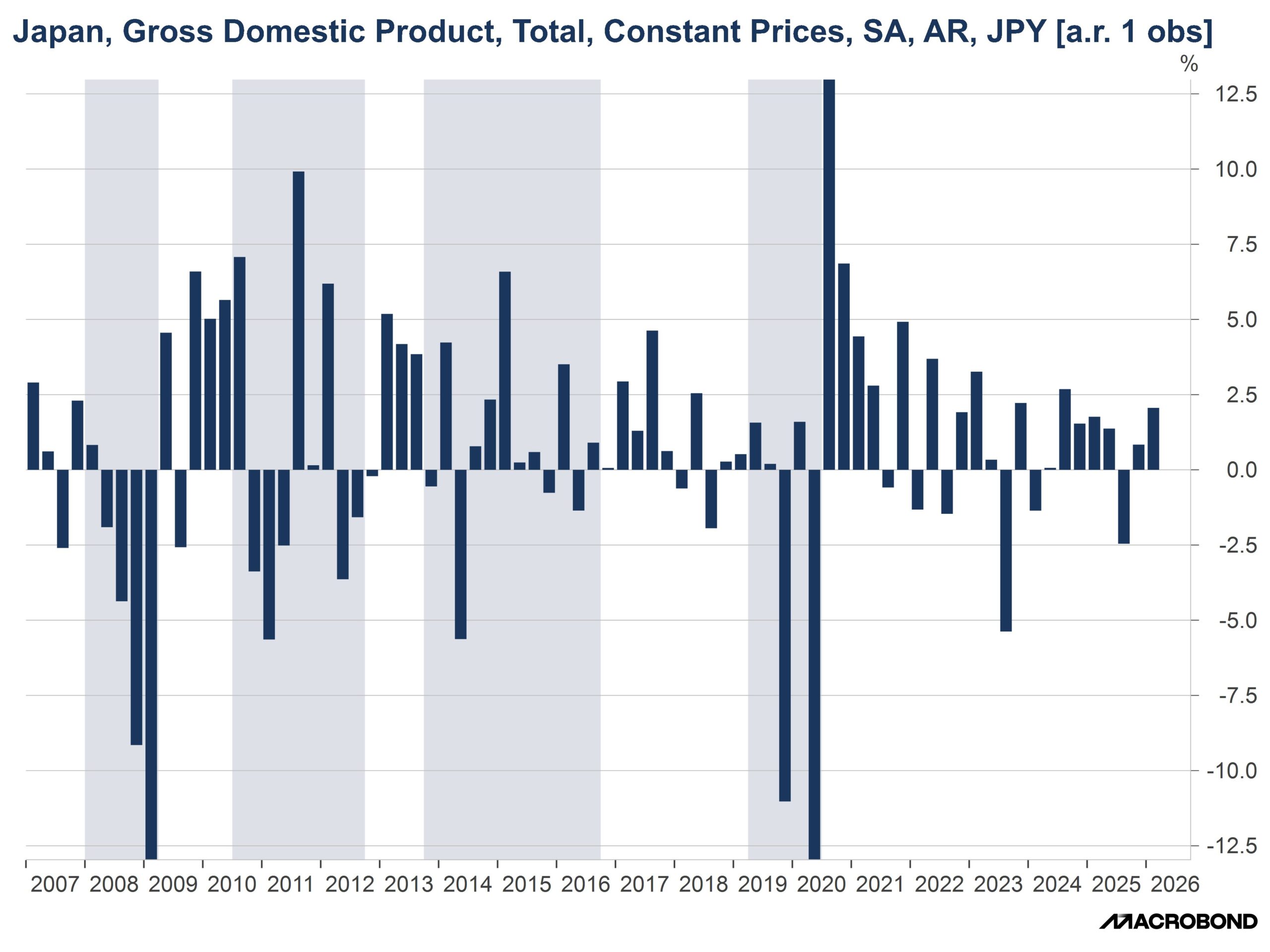
Japan: Excluding price changes and seasonal impacts, first-quarter gross domestic product grew at an annualized rate of 2.1%, far better than the anticipated increase and more than double the revised 0.8% growth rate in the previous quarter. The strong growth came mostly from surprisingly robust increases in personal consumption spending and international trade. Coupled with continued high price inflation, the GDP figure will likely help prompt the Bank of Japan to keep raising interest rates, perhaps explaining why Japanese stocks have declined on the news.
China-Russia: General Secretary Xi today will host Russian President Putin for a summit in Beijing, with much media expectation that the two leaders could sign a deal on the proposed Power of Siberia 2 natural gas pipeline, which would channel some 50 billion cubic meters of Russian gas to China each year. The leaders last year agreed to move forward with the design of the pipeline, which is a priority for Putin, but Xi is driving a hard bargain on the price of the gas and appears reluctant to make a long-term commitment as he develops China’s other energy sources.
- If Xi and Putin reach a deal on POS 2, the Chinese and Russian economies would be even more tightly integrated, replacing some of Russia’s prior focus on supplying energy to Europe and reducing China’s reliance on energy shipped through the Strait of Hormuz.
- Longer term, if Russia’s war against Ukraine ends and the Europeans want to buy more energy from Russia again, any deal for POS 2 could divert supplies that would otherwise be available for Europe.
China: In an interview with the Financial Times, the CEO of Tianqi Lithium, one of China’s biggest lithium producers, warned that even the most bullish investors were underestimating the likely demand for the mineral as battery power is applied to more industries. For example, the CEO discussed how batteries will be increasingly used in trucking, mining equipment, and ships. The CEO, Frank Ha, may well be “talking his book,” but his statement does highlight how the demand for batteries is booming (see note below regarding Ford’s new battery business).
France-Sweden: The Swedish government today selected France’s state-owned Naval Group to build four new frigates aimed at helping modernize the Swedish navy. The losing bidders were a joint effort by the UK’s Babcock International and Sweden’s own Saab and a group led by Spain’s Navantia, both of which offered newly designed vessels. Importantly, Stockholm said it awarded the contract to Naval Group because its FDI frigates are already in service with France and Greece.
- As European militaries rush to rebuild and modernize amid increasing threats from Russia and growing US reluctance to support the Continent’s defense, we continue to believe that international defense stocks are likely to perform well into the future.
- Because of today’s revolution in defense technology, including new weapons such as drones and hypersonics, much of the opportunity will likely come from start-up “defense tech” companies after they hold their initial public offerings. In the meantime, the Swedish deal shows how established defense firms with tried-and-true weapons systems will also benefit in the near term.
US Artificial Intelligence Industry: Bucking the enthusiasm for AI investments among many technology executives, the CEO of storage disk maker Seagate Technology yesterday said his firm won’t meet surging data center demand because new factory buildouts would take too long and risk future overcapacity. In response, Seagate’s stock price plunged 6.9%. We think the statement could signal the beginning of increased capital discipline and caution against the current AI frenzy. If so, it could portend a correction in tech prices in the future.
US Electricity Industry: While most investors yesterday focused on the announcement of a major AI-driven merger of electricity utilities NextEra and Dominion, we found it just as notable that Ford Motor Company has launched a new unit to build large-scale industrial batteries. In fact, the firm announced yesterday that it has struck a deal to provide up to 20 gigawatt-hours of battery energy storage capability over five years to power company EDF. Together, these transactions illustrate how the AI boom continues to spark new electricity investment and innovation.
US Stock Market: According to the Wall Street Journal today, stock buybacks by the six Magnificent 7 firms that have reported first-quarter earnings so far were down 71% from their level one year earlier. The article posits that Nvidia, the last of the Mag 7 companies to report, could buck the trend with an increase in its buybacks.
- Still, the overall figures illustrate how increased capital investment due to the AI boom is affecting the financial position of top tech firms.
- Importantly, fewer stock buybacks will be a headwind for earnings per share growth, potentially weighing on the major tech firms’ valuations.