


Daily Comment (March 27, 2026)
by Patrick Fearon-Hernandez, CFA, and Thomas Wash
[Posted: 9:30 AM ET] | PDF
Our Comment opens with a discussion of proposed reforms to US monetary policy. We then provide a fresh update on the conflict in Iran. In addition, we examine Google’s latest breakthrough and its implications for the market for memory chips, the impact of immigration crackdowns on population trends, and a new Chinese probe into US trade practices. As always, we include a summary of recent US and international economic data releases.
Fed Reform: The Federal Reserve could be set for a makeover once current Chair Jerome Powell steps down in May. The US Treasury Secretary Scott Bessent is considering ways to expand Treasury oversight of the central bank after a successor is named, with the possibility of making the Fed look more like the Bank of England. The change will likely be welcomed by Fed Chair nominee Kevin Warsh, who seeks reforms that influence not only the agency’s decision-making process but also its balance sheet management.
- Bessent is specifically targeting changes to the Fed’s operational independence. In a paper for International Economy magazine, he argued for revising how the Fed conducts quantitative easing, which he characterizes as a kind of “gain‑of‑function” policy experiment. He has also expressed support for a model of more limited interaction between the central bank and the government, similar to the Bank of England’s approach during the gilt market crisis.
- His proposals may also find support from Warsh, who had previously argued that the Bank of England manages its balance sheet more effectively than the United States. In 2014, Warsh served on a committee tasked with reviewing the Bank of England’s operations. He later praised the BoE’s practice of requiring governors to write formal letters to the chancellor to explain key decisions, arguing that this system clarifies the rationale for policy moves and enhances transparency.
- Potential changes to Fed policies are likely to intensify scrutiny over whether the central bank can maintain its independence, especially after several unsuccessful efforts to remove senior officials. Earlier this week, Jeanine Pirro, who had accused Chair Jerome Powell of lying under oath, conceded there was no evidence of wrongdoing. At the same time, questions have also emerged around the inquiry into whether Governor Lisa Cook misrepresented information on a loan application to secure more favorable terms.
- That said, whether or not the Fed will ultimately move closer to the BoE model, it does appear likely that it will keep trimming the size of its balance sheet. Fed Governor Stephen Miran has argued that, with targeted deregulation and reduced stigma around the use of the Fed’s lending facilities, the central bank could shrink its balance sheet by as much as $2 trillion without materially tightening financial conditions.
- We suspect the US Treasury and the Federal Reserve will maintain a close working relationship over the next few years as they navigate the impact of policy on long‑term interest rates. While any perception of coordination may draw scrutiny, clearer communication and more predictable operations from both institutions could help tame bond‑market volatility.
Iran Update: The war is now entering its fifth week, at the edge of the four‑to‑five‑week window the White House initially floated. On Thursday, President Trump announced that he had extended the timeline for a potential strike on Iran’s nuclear facilities, citing progress in ongoing talks. At the same time, Iran’s attacks appear to have intensified, signaling that it is not yet prepared to de-escalate the conflict. Meanwhile, trade through the strait is beginning to show signs of improvement, suggesting that there may be more that is unfolding behind the scenes.
- The president appears to be working through Middle East proxies to develop an off-ramp to the conflict. He has stated that he has been able to communicate with Iranian leadership through Pakistan, and that negotiations have so far gone well. This progress that led him to extend his deadline for targeting some of Iran’s critical infrastructure by 10 days. He later explained that the extension would allow the US to deploy as many as 10,000 additional troops to the Middle East.
- However, progress toward a deal has not yet produced a meaningful break in the fighting between the two sides. Israel and Iran continue to trade missile strikes. On Thursday, Israel announced that it had struck three of Iran’s ballistic missile and air defense systems. Meanwhile, Kuwait reported that two of its commercial ports were hit, while Saudi Arabia said it was forced to intercept Iranian missiles headed toward its capital, Riyadh.
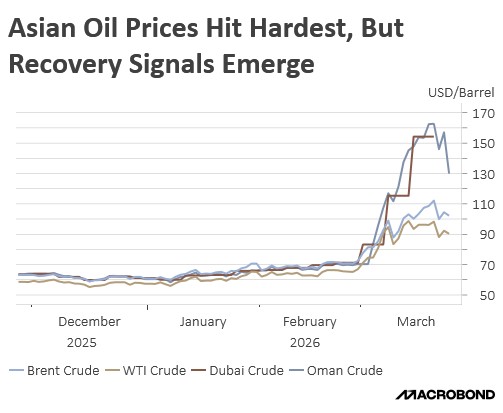
- The conflict has nonetheless underscored Iran’s ability to disrupt traffic through the Strait of Hormuz. Despite US efforts, Washington has struggled to provide reliable naval escorts, with one analyst likening ships sailing under US or Israeli flags to “sitting ducks.” By contrast, vessels from friendlier countries such as China and India have generally found it easier to transit the strait, helping ease prices for Oman crude, which is largely shipped to Asia. Even so, new reports show that even these shipments are beginning to be turned away.
- Over the coming days, the market is expected to monitor developments more closely and may begin to price in a de-escalation of the conflict. Signs of concrete progress toward a resolution would likely facilitate a relief recovery; however, this sentiment remains fragile and could quickly reverse if market patience is tested. Given the current uncertainty, we recommend maintaining a conservative investment profile, prioritizing profitability and value over high-growth assets, as the situation unfolds.
Memory Disruption: A breakthrough from Google parent company Alphabet has triggered a selloff in memory‑chip stocks. The tech giant released a new paper describing an algorithm that could significantly increase the efficiency of the data storage needed to train and run artificial intelligence systems. If widely adopted, the innovation could reduce reliance on high‑end memory chips, which have been in short supply amid the AI infrastructure boom. That shift could be a boon for AI developers but a headwind for chipmakers.
Immigration Crackdown: The initiative to reduce immigrant populations has resulted in a contraction across 40% of US counties. This sharp demographic shift may partially explain the recent softening of the labor market. Historically, stagnant or declining population growth has weighed on overall economic expansion; however, this trend could be counterbalanced by a surge in productivity, particularly if AI adoption accelerates.
Beijing Probes US: Chinese regulators have launched an investigation into US trade practices, a move that follows the announcement of President Trump’s scheduled visit to China in mid-May. The probe is expected to focus on trade policies that disrupt global supply chains and restrictions on green technology. Furthermore, the investigation will likely define the parameters for a potential trade agreement as both sides convene to resolve their economic differences.