


Daily Comment (March 25, 2026)
by Patrick Fearon-Hernandez, CFA, and Thomas Wash
[Posted: 9:30 AM ET] | PDF
Our Comment opens by highlighting growing optimism that there is now a plausible pathway toward de‑escalation in the Middle East conflict. We then examine why expectations are building that the Federal Reserve may be preparing for a more hawkish policy stance. In addition, we discuss the Pentagon’s potential setback in its lawsuit with Anthropic and the emergence of Arm as a serious new rival in the chipmaking space. As always, we include a summary of recent US and international economic data releases.
Easing Tensions? The market gained cautious optimism following signs that the White House is engaging in direct talks with the Iranian leadership. On Tuesday, President Trump suggested that negotiations were progressing, claiming Tehran had offered a “present” as a sign of good faith. While these claims were quickly undermined by additional US troop deployments and Tehran’s refusal to acknowledge talks, the market continues to hold out hope that cooler heads will prevail as it awaits an end to the conflict.
- The easing of tensions appears to be part of a White House effort to build momentum after Monday’s announcement of a five-day pause before deciding whether to strike Iran’s power infrastructure. It has been reported that the US has presented a 15-point peace plan, several elements of which Iran had previously signaled it could accept. Although it is still unclear who will attend any meetings, US officials are working to start talks with Iranian representatives on Thursday.
- While the White House has pushed for diplomacy, Iran has publicly rejected claims that it is willing to end the conflict. The failure to acknowledge talks comes as Iranian officials express distrust that the US, or even their own leadership, might use peace negotiations as a means to compromise their position or security. As a result, Iranian officials have stated they are not prepared to engage in negotiations as long as attacks continue and have warned that the Strait of Hormuz will remain closed.
- Despite Iranian resistance, there is growing international pressure to bring both sides to the negotiating table. China’s foreign minister, Wang Yi, has urged Iran to consider talks with the US, insisting the crisis should be resolved through diplomacy rather than force. At the same time, a group of Middle Eastern states, including Pakistan, Egypt, and Turkey, has moved to establish a backchannel between Washington and Tehran to facilitate potential negotiations.
- Even so, Iran has offered a limited concession, indicating it will allow non‑hostile vessels to transit the strait, amid reports it is charging fees of up to $2 million per voyage. This levy signals Tehran’s effort to assert de facto control over the waterway, while also suggesting that commercial shipments may face fewer outright blockages. On Tuesday, reports indicated that a Thai-flagged vessel successfully passed through the contested waters.
- Hopes of easing tensions have fueled a rebound in risk assets, with gold and silver prices recouping some of their recent losses. In the short term, we expect a fragile recovery that could strengthen over time as confidence grows that the conflict will end. This could lead market attention to shift from concerns about escalation to an assessment of the broader impact of the conflict. Looking ahead, investors may begin to favor companies that show earnings resilience and operational efficiency.
Fed Expectations: The sudden rise in energy and commodity prices has led to concerns that the Federal Reserve may need to make a hawkish pivot later this year. Earlier this week, Chicago Fed President Austan Goolsbee was the first to publicly state that tightening could be on the table. Speaking with CNBC, he said he could be open to a rate hike depending on how the conflict plays out. Although he also noted that rate cuts remain a possibility, his remarks show that inflation concerns are rising within the FOMC.
- Goolsbee’s comments suggest that the Fed’s focus may be shifting away from its maximum employment mandate in favor of price stability. Following the recent Fed meeting on March 17–18, Powell acknowledged that several board members could also see a rate hike in the future, though it is not the base case for the majority. However, he indicated the Fed is prepared to take appropriate action if inflationary pressures begin to build due to the Iran conflict.
- That said, even as the tone has shifted, the FOMC has also signaled that it is prepared to adopt a wait‑and‑see stance before pivoting toward rate hikes. On Tuesday, Fed Governor Michael Barr indicated that rates may need to be held steady for some time as the conflict unfolds, while Governor Stephen Miran suggested that although higher oil prices could push up goods and energy costs, he remains optimistic that the Fed could still cut rates several times this year.
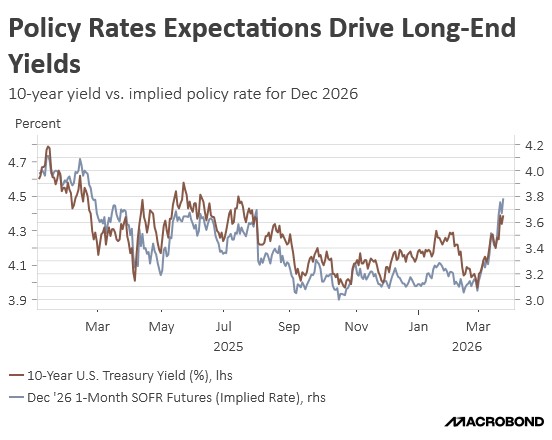
- Markets are already leaning more hawkish, even as Fed officials remain non‑committal about how the Iran war will ultimately shape policy. The latest one‑month SOFR futures for December indicate that investors now expect the Fed to keep rates on hold, with some probability assigned to a hike before year‑end, whereas before the conflict, they had been pricing in as many as two cuts.
- A potential hawkish shift by the Federal Reserve is likely to remain a central theme even after the conflict ends, as the economy braces for renewed inflationary pressures in the coming months. For now, we remain skeptical that the Fed will be willing to vote for another rate hike, given the significant political pressure from the White House. That said, we have grown less optimistic about the Fed’s ability to cut rates without clear signs that the labor market outlook has begun to deteriorate.
Pentagon Anthropic: A judge signaled that she may not side with the US government in its dispute with Anthropic. The judge overseeing the case stated that the Pentagon was using the removal of its contract as punishment for Anthropic taking its dispute public over the use of AI. The comments suggest that the government’s ability to award or withdraw contracts at will is likely to be taken up by the Supreme Court. The ongoing fight is expected to have implications for future public-private partnerships as the government gets more involved in the economy.
Chip Rivals: More companies are looking for ways to bypass major chipmakers by designing their own semiconductors. Arm appears to be making headway in this shift after announcing that it has developed its own chips, potentially allowing it to compete more directly with larger manufacturers. The company expects orders to rise following reported commitments from Meta and OpenAI. The emergence of new chip rivals is likely to accelerate as AI becomes a more prominent force in the global economy.