


Daily Comment (January 26, 2026)
by Patrick Fearon-Hernandez, CFA, and Thomas Wash
[Posted: 9:30 AM ET] | PDF
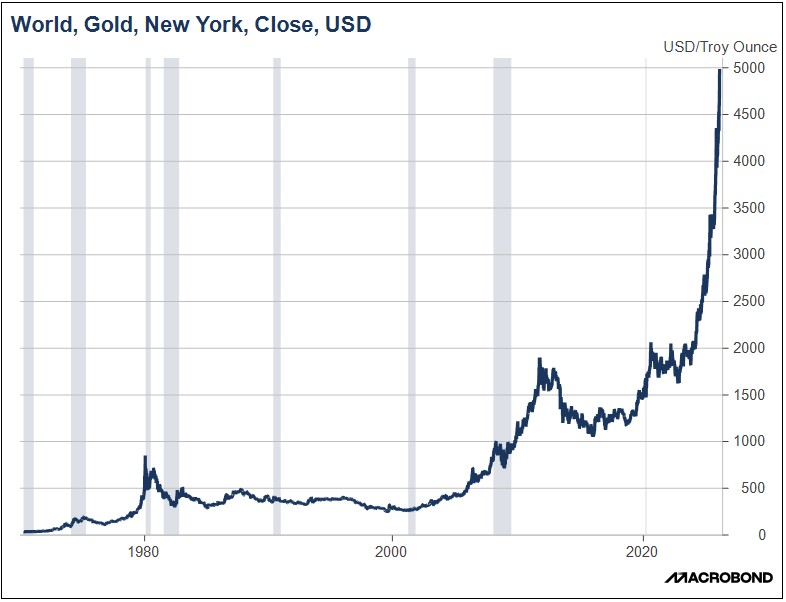
Our Comment today opens with notes on the new record price for gold above $5,000 per ounce and a related drop in the value of the dollar today. We next review several other international and US developments with the potential to affect the financial markets today, including an additional purge of a high-level Chinese general and the unexpected risk of another, partial government shutdown in the US.
Global Gold Market: Gold prices today have surged above the $5,000-per-ounce mark for the first time, and the metal is changing hands at $5,084 per ounce at this writing. In our view, the current upward pressure on gold prices reflects a range of factors, from concerns about currency debasement to geopolitical tensions and uncertainty about the future of US economic and international policy. Because of those factors, we continue to hold gold in all five of our Asset Allocation strategies and in our Global Hard Assets portfolio.
Global Currency Market: In another major market disruption today, the US dollar has slumped approximately 0.4%, as measured by the US Dollar Index. That means the greenback has now depreciated by about 2.1% just over the last week. Much of the downward pressure today comes from speculation that the Japanese government will intervene in the currency markets to prop up the yen. As we have noted in the past, a falling dollar tends to be bullish for foreign stocks.
United States-Canada-China: In a Saturday social media post, President Trump said he would impose a new 100% tariff on imports from Canada if Ottawa strikes a trade deal with Beijing. The move follows Canadian Prime Minister Carney’s recent trip to China, where he and General Secretary Xi agreed to cut their trade barriers on electric vehicles and canola oil — a move seemingly at odds with Carney’s historic speech in Davos, where he said “middle powers” like Canada must stick together instead of making deals with the Great Powers.
- Coupled with the president’s threat to hit eight European countries with tariffs because of their resistance to his desire for the US to take over Greenland, the new threat against Canada is a reminder that the administration could return to its aggressive trade policies at any time.
- That’s likely to further raise concerns among foreigners about the wisdom of investing in US assets or holding the dollar. If so, it could lead to further capital flight from the US, weighing on stock and bond values, pushing up interest rates, and reducing the value of the dollar. That scenario would also put added upward pressure on the prices for foreign stocks and precious metals.
Chinese Military: The People’s Liberation Army announced on Saturday that Zhang Youxia, vice chairman of the Central Military Commission, is under investigation for “serious discipline violations,” along with another top general. That suggests General Secretary Xi is continuing to press his long campaign to uproot deep-seated corruption in the armed forces. It also suggests Xi may have trouble trusting his military leaders’ advice and willingness to carry out orders — a concern that would likely impede any effort by Xi to take control of Taiwan.
- According to press reports, government officials said in a confidential briefing over the weekend that Zhang was being probed not only for political reasons and graft, but also for leaking details about China’s nuclear weapons to the West.
- If true, the accusation of selling nuclear secrets could suggest the Central Intelligence Agency has had some success in rebuilding its human spy network in China after having its previous network rolled up in conjunction with a mole at the agency over a decade ago. That would be consistent with our oft-stated belief that a US-China intelligence war was in full swing in recent years, at least until the administration’s recent effort to establish détente between the two countries.
Chinese Tech Industry: According to Bloomberg late last week, tech giants Alibaba and Baidu both plan to list their semiconductor-design units in the near future. Other Chinese firms are also reportedly planning chip-design IPOs or have recently completed them. The IPOs illustrate how China is making rapid progress developing its indigenous ability to produce chips for artificial intelligence. Indeed, the capital raised in these deals will likely accelerate the Chinese firms’ ability to compete with US tech giants such as Nvidia.
United Kingdom: Suella Braverman, the Conservative Party’s former home secretary, today became the latest prominent politician to defect from the center-right party to join the right-wing populist Reform UK Party run by Nigel Farage. With Reform UK leading in the public opinion polls ahead of key elections on May 7, many Conservative politicians see better electoral prospects by joining the new party, putting the future of the Conservative Party in doubt and strengthening Britain’s far-right.
US Fiscal Policy: After Immigration and Citizenship Enforcement officers shot and killed a US citizen in Minneapolis, Democratic Party leaders over the weekend said they may vote against a major appropriations bill that would fund the Department of Homeland Security as well as the Departments of Defense, Health and Human Services, Transportation, and Labor. Such a protest vote would shut down much of the federal government and potentially furlough thousands of workers again when the current stopgap funding bill runs out on January 31.
- The impact on the economy would likely be less than in last year’s broader shutdown.
- All the same, shutting down a department such as Labor could again disrupt the compilation of key economic data.
US Defense Strategy: The Pentagon on Friday released its new National Defense Strategy, which complements the administration’s December National Security Strategy. Focusing on how the administration plans to use the US military, the document raises “homeland defense” to the top priority and downgrades countering China to second place. It also says the administration will keep pushing US allies to take primary responsibility for their own defense. All the same, it vows to revitalize the US defense industrial base, which could be positive for US defense stocks.
US Weather: The big winter storm that struck from the Southwest to the Northeast over the weekend continues to disrupt life for up to 200 million US residents. At this point, the storm has caused almost 12,000 flight cancellations and has left approximately 900,000 people without power, mostly in the South. So far, it looks like Nashville is the hardest hit city, with 200,000 people going without electricity today. As always, we expect that any economic disruptions from such a large storm will prove temporary and have little lasting effect on the economy.